How to Become an Accredited Investor in 2026
Learn the income, net worth, and professional requirements for accredited investor status, including how verification works and what to check before investing.

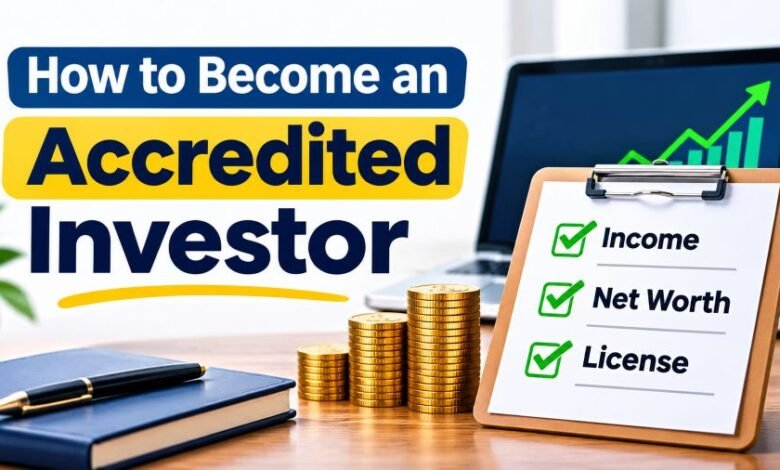
Last Updated on November 21, 2026 by Business Blog Media Editorial Team
Want to invest in private companies? Some opportunities have special entry rules.
One involves accredited investor status.
The name sounds complicated. But the basic idea is simple.
An accredited investor meets certain financial or professional standards under U.S. securities law. This can allow them to invest in private offerings that are restricted to certain investors.
You don’t always need millions. Some people qualify through income. Others qualify through professional licenses.
So, how do you become one?
Here is what the U.S. Securities and Exchange Commission (SEC) requires in 2026.
Quick Facts About Accredited Investors
| Detail | Information |
|---|---|
| Investor classification | Accredited Investor |
| Main regulator | U.S. Securities and Exchange Commission (SEC) |
| Main legal rule | Rule 501(a) of Regulation D |
| Individual income requirement | More than $200,000 annually |
| Joint income requirement | More than $300,000 annually |
| Net worth requirement | More than $1 million |
| Primary residence | Excluded from net worth |
| Qualifying licenses | Series 7, Series 65, Series 82 |
| SEC application required | No |
| Government-issued certificate | No universal certificate |
| Verification | Depends on the investment offering |
| Main purpose | Eligibility for certain private securities offerings |
| Requirements reviewed | November 2026 |
What Is an Accredited Investor?
An accredited investor is a person or organization that meets specific conditions set by U.S. securities law.
These conditions cover money, professional qualifications, or certain business roles.
Why does this status exist?
Private investments often involve higher risks. They may also provide less public information.
The SEC uses accredited investor requirements to determine who can participate in certain offerings that are exempt from registration.
For example, a startup might raise money privately. It may offer shares to accredited investors rather than selling shares through a public stock exchange.
Private equity funds can work similarly.
But accreditation doesn’t mean guaranteed profits.
An investor can still lose everything.
Accredited Investor Requirements in 2026
There are several ways to qualify. You only need to meet one eligible category.
For most individual investors, the main choices are income, net worth, or professional credentials.
1. Qualify Through Annual Income
The income route is straightforward.
You must have earned more than $200,000 individually in each of the previous two years.
You must also reasonably expect to earn more than $200,000 during the current year.
For married couples or people with a qualifying spousal equivalent, the joint income threshold is more than $300,000.
Let’s use 2026 as an example.
| Year | Individual Income | Joint Income |
|---|---|---|
| 2024 | More than $200,000 | More than $300,000 |
| 2025 | More than $200,000 | More than $300,000 |
| 2026 | Reasonably expect the same threshold | Reasonably expect the same threshold |
Here’s an important detail.
Earning exactly $200,000 isn’t enough. The rule says income must exceed that amount.
A single high-income year won’t work either.
You need the required income history.
2. Qualify Through Net Worth
This is another common route.
Your qualifying net worth must exceed $1 million.
You can calculate it individually. You can also combine qualifying net worth with a spouse or spousal equivalent.
Your primary residence doesn’t count.
That point matters a lot.
Someone might own a $900,000 home. But its value cannot be counted toward the accredited investor net worth test.
Other qualifying assets may count.
These can include:
- Cash and savings accounts
- Stocks and bonds
- Investment accounts
- Retirement accounts
- Certain business ownership interests
- Rental and investment properties
You must subtract applicable liabilities.
Personal loans and credit card debts are common examples.
Most primary-home mortgage debt is treated differently. Special rules apply to excess mortgage debt and certain recent borrowing.
Example of an Accredited Investor Net Worth Calculation
Imagine someone owns these assets:
| Financial Item | Amount |
|---|---|
| Savings | $250,000 |
| Stocks and bonds | $500,000 |
| Retirement investments | $350,000 |
| Total qualifying assets | $1,100,000 |
| Other liabilities | $50,000 |
| Estimated net worth | $1,050,000 |
This person exceeds the $1 million requirement.
They may qualify through net worth.
The example assumes all listed assets qualify and all applicable liabilities are included.
The final figure needs accurate records.
3. Qualify Through Professional Licenses
Not everyone qualifies through wealth.
Some financial professionals can qualify based on their licenses.
The SEC currently recognizes three designated securities licenses.
| License | Description |
|---|---|
| Series 7 | General Securities Representative |
| Series 65 | Investment Adviser Representative |
| Series 82 | Private Securities Offerings Representative |
These licenses must be held in good standing.
The Series 65 route interests many people.
Candidates can generally take the Series 65 examination without a sponsoring brokerage firm.
Still, passing the examination alone isn’t enough.
The person must meet the applicable licensing and registration requirements to hold the qualifying designation in good standing.
Series 7 and Series 82 have different sponsorship and registration requirements.
So, don’t assume any finance course grants accredited status.
It doesn’t work that way.
4. Qualify Through Certain Company Roles
Some business professionals qualify through their positions.
These may include qualifying directors, executive officers, or general partners of the company selling the securities.
The rule also covers certain leaders of a general partner.
But there’s a limit.
Holding a management title doesn’t automatically make someone accredited for every unrelated investment.
The qualifying relationship matters.
5. Qualify as a Knowledgeable Employee
Certain employees of private investment funds may qualify.
This category can cover qualifying directors, executives, and employees who participate in investment activities.
But the status is limited.
It applies to eligible investments in their fund or other qualifying funds managed by their employer.
It isn’t universal access to every private offering.
How to Become an Accredited Investor
The process starts with checking your eligibility.
You don’t apply for a general SEC accreditation license.
Instead, you establish whether you meet the legal requirements.
Step 1: Check Your Financial Position
Start with your finances.
Review your income history. Then calculate your qualifying net worth.
Be accurate with every figure.
Include your eligible investment assets. Subtract the liabilities that count.
Don’t include your primary home’s value.
If you already meet one test, you may qualify.
Step 2: Check Professional Eligibility
Maybe your finances fall short.
That’s not always the end.
Look at the professional qualification routes.
Do you hold Series 7, Series 65, or Series 82 in good standing?
Or do you hold an eligible business or private-fund role?
If so, examine that category carefully.
Professional status must meet the rule’s exact conditions.
Step 3: Gather Supporting Documents
Now prepare your records.
You may need proof of income. You may need proof of assets.
Common documents include:
- Federal tax returns
- W-2 or 1099 forms
- Bank statements
- Brokerage statements
- Credit reports
- Professional-license records
- Confirmation from an eligible financial or legal professional
The required evidence depends on the offering.
Keep your records accurate and current.
Step 4: Find an Eligible Investment
Once you meet a qualifying category, you can consider private investment opportunities.
Some startups raise money privately.
Certain real estate projects do too.
Private investment funds may also accept accredited investors.
But each offering has its own conditions.
Meeting the SEC definition doesn’t guarantee acceptance.
The investment manager may still reject an application.
Step 5: Complete Investor Verification
The company may ask questions.
It might request financial documents. It may use an outside verification provider.
Some investors use confirmation letters from qualified professionals.
The process depends on the securities exemption being used.
A simple checkbox may not be sufficient.
Step 6: Review Everything Before Investing
This part deserves real attention.
Read the offering documents carefully.
Check how the business earns money. Look at its debt and financial position.
Ask about management experience.
Find out when you can sell.
Private investments often lack an easy exit.
You may need to hold them for years.
Never assume accreditation means safety.
How Does Accredited Investor Verification Work?
Two common private offering rules are Rule 506(b) and Rule 506(c).
They have different requirements.
| Rule | Verification Standard |
|---|---|
| Rule 506(b) | The issuer must have a reasonable belief that the investor qualifies |
| Rule 506(c) | The issuer must take reasonable steps to verify accredited status |
Rule 506(c) allows public advertising of qualifying offerings.
But purchasers must be accredited.
Rule 506(b) generally prohibits public solicitation. It can allow a limited number of sophisticated non-accredited investors under specific conditions.
Verification may involve financial documents.
A registered broker-dealer, SEC-registered investment adviser, licensed attorney, or CPA can also provide qualifying written confirmation.
There is no single verification method for every situation.
How Much Does It Cost to Become an Accredited Investor?
There is no universal SEC application fee.
If you already meet the financial requirements, you don’t have to buy accredited status.
Still, some related expenses may arise.
Third-party verification services may charge fees.
Professional confirmation may cost money too.
Someone pursuing a qualifying securities license may face examination, registration, and maintenance costs.
These expenses aren’t the same as buying accreditation.
And remember, the investment itself may require substantial capital.
Each offering sets its own minimum.
Can You Become an Accredited Investor Without $1 Million?
Yes. That’s possible.
The net worth route isn’t the only option.
A person earning more than $200,000 annually for the required period may qualify without $1 million in assets.
A qualifying professional license can provide another route.
Certain issuer executives and knowledgeable employees may also qualify under specific conditions.
But here’s the catch.
Simply having investment experience isn’t enough.
You must meet an actual legal category.
Can an LLC or Business Become an Accredited Investor?
Yes. Certain business entities can qualify.
The SEC recognizes several categories.
These include eligible corporations, partnerships, LLCs, trusts, and other organizations.
For many entity categories, the asset threshold is more than $5 million.
Other legal conditions may apply.
Some entities qualify because all their equity owners are accredited investors.
Certain registered financial institutions and investment advisers have separate qualifying categories.
An LLC doesn’t automatically qualify just because it exists.
Its structure, owners, assets, or regulated status must meet the applicable rule.
What Investments Can Accredited Investors Access?
Accredited status may open access to certain private securities offerings.
Here are common examples.
Startup Investments
Some startups raise money privately.
Accredited investors may purchase eligible securities before the company becomes publicly traded.
But startup investing carries serious risks.
Many businesses fail.
Early investors may lose their money.
Private Equity Funds
Private equity funds invest in businesses outside public stock markets.
They may buy companies or take significant ownership stakes.
Some funds limit participation to eligible investors.
They may also require other qualifications.
Venture Capital Funds
Venture capital funds often invest in young companies.
These businesses may have limited operating histories.
Returns are uncertain.
A successful investment can grow substantially, while others may lose their value.
Private Real Estate Investments
Some commercial property projects raise capital through private offerings.
These may involve apartment buildings, office properties, or development projects.
Investors should check debt levels, fees, ownership terms, and project risks.
Hedge Funds and Private Credit
Certain hedge funds and private lending funds accept accredited investors.
Their strategies and risks vary.
Some may require qualified purchaser status or another eligibility standard.
Being accredited alone doesn’t guarantee entry.
Benefits of Being an Accredited Investor
The main benefit is access.
You may become eligible for private offerings unavailable to many retail investors.
This can provide more investment choices.
Some investors want exposure to startups. Others prefer private funds or property-related securities.
There may be opportunities for long-term returns.
But nothing is guaranteed.
Accredited status mainly expands eligibility. It doesn’t establish whether an investment is suitable for your finances.
What Are the Risks?
Private investing can be tough.
Some investments are difficult to sell.
You might wait years for a buyer.
Financial disclosures may be limited.
A company may also fail.
And high fees can reduce investment returns.
Watch for unrealistic profit promises.
Be especially careful with pressure tactics.
The SEC does not approve individual private investment offerings simply because they are made under Regulation D.
A Form D filing isn’t a government endorsement.
Investors should review offering documents and check the people involved before committing funds.
Accredited Investor vs. Non-Accredited Investor
Both groups can invest.
The main difference involves eligibility for certain restricted offerings.
| Accredited Investor | Non-Accredited Investor |
|---|---|
| Meets an SEC qualifying category | Does not meet an accredited category |
| May participate in certain restricted private offerings | Has more limited access to those offerings |
| Can purchase in qualifying Rule 506(c) offerings | Cannot purchase in Rule 506(c) offerings |
| Still faces investment risks | Still faces investment risks |
| Can invest in public securities | Can invest in public securities |
Non-accredited investors can still buy ordinary stocks, ETFs, and mutual funds.
They may also access eligible crowdfunding investments under applicable rules.
So accreditation isn’t required for everyday stock investing.
Accredited Investor vs. Qualified Purchaser
These terms aren’t identical.
An accredited investor may qualify through income, net worth, or specific professional standards.
A qualified purchaser follows a different legal definition.
For an individual, qualified purchaser status generally requires at least $5 million in qualifying investments.
Certain entities have other requirements.
Some private funds use qualified purchaser eligibility rules.
So meeting the accredited investor test doesn’t automatically establish qualified purchaser status.
Does Accredited Investor Status Expire?
There is no universal expiration date.
But your eligibility can change.
For example, someone’s net worth may fall below the required threshold.
Professional licensing status may also change.
A company can reassess eligibility when you make another investment.
Earlier verification doesn’t guarantee permanent qualification.
Can Foreign Investors Qualify?
U.S. citizenship isn’t a general requirement in the individual income or net worth categories.
An overseas investor may satisfy the SEC definition.
But individual offerings can have extra conditions.
Identity checks and tax documentation may apply.
Local securities laws can matter too.
Some platforms may restrict investors based on residency.
So foreign investors should check the offering’s actual rules before applying.
What Changed for Accredited Investors in 2026?
The main financial thresholds remain unchanged.
Individual income must exceed $200,000.
Joint income must exceed $300,000.
Qualifying net worth must exceed $1 million.
But the SEC is considering more ways to qualify.
In September 2026, it sought public comment on possible additional professional and examination routes.
These include a proposed FINRA accredited investor examination and certain professional credentials, such as CPA, CFA, and CFP qualifications.
Series 79, Series 86, and Series 87 licenses are also under consideration.
These are proposed possibilities, not established additional qualification routes as of November 21, 2026.
The currently recognized license categories remain Series 7, Series 65, and Series 82.
Common Mistakes to Avoid
Some investors misunderstand the rules.
One mistake is counting the primary residence toward qualifying net worth.
Another is assuming one strong income year is enough.
Some people believe an investment course automatically qualifies them.
It doesn’t.
Others assume a verification letter guarantees access to any private fund.
That isn’t true either.
Investment eligibility and investment acceptance are different.
And before sending money, check the issuer.
Review the documents. Ask direct questions.
A legitimate investment should withstand careful examination.
Final Thought
Becoming an accredited investor doesn’t always require great wealth.
Income can qualify you. Professional credentials may work too.
The first move is simple.
Check which legal category fits your situation.
Then gather accurate records.
If an investment requires verification, follow the issuer’s process.
But don’t rush the investment decision.
Private offerings can carry serious risks.
Accredited status gives eligible investors more choices. Good research still matters.
Frequently Asked Questions (FAQs)
1. How do I become an accredited investor in 2026?
You must meet an eligible SEC category. Common routes include qualifying income, net worth exceeding $1 million, or holding an approved professional license in good standing.
2. Can I become an accredited investor without being rich?
Yes. Some people qualify through professional credentials or specific company roles. You don’t necessarily need $1 million in assets.
3. Is there an accredited investor exam?
There is no general standalone SEC accredited investor examination in effect as of November 2026. The SEC is considering a possible FINRA examination as an additional future route.
4. Does the Series 65 exam make you an accredited investor?
Not by itself. You must also meet the applicable licensing and registration requirements to hold the qualifying designation in good standing.
5. Can I become an accredited investor online?
You may complete investor questionnaires and verification online. But eligibility still depends on meeting the legal criteria.
6. How long does accredited investor verification take?
There is no universal processing period. The time depends on the investment provider, verification method, and required documents.
7. Do I need a certificate to be an accredited investor?
No universal government-issued certificate exists. An issuer may request records or professional confirmation to verify your status.
8. Can accredited investors lose their money?
Yes. Private investments can lose part or all of their value. Accreditation provides no protection against investment losses.