Advantages and Disadvantages of Franchising: Benefits, Risks, and Real Business Insights
A complete look at franchise benefits, challenges, costs, and ownership realities.

Last Updated on August 25, 2026 by Business Blog Media Editorial Team
Starting a business sounds simple until you actually do it.
Finding customers. Building trust. Creating systems. Managing suppliers. Handling daily operations.
Every new entrepreneur faces these challenges.
This is why many people consider franchising.
A franchise gives entrepreneurs the opportunity to operate a business using an established brand, proven methods, and existing support systems. Instead of creating everything from zero, franchise owners follow a model that has already been developed by another company.
But there is a trade-off.
You gain a recognised name and guidance.
You also accept rules, fees, and less freedom.
Understanding the advantages and disadvantages of franchising helps entrepreneurs decide whether this business model matches their goals, budget, and working style.
Quick Answer: What Are the Advantages and Disadvantages of Franchising?
Franchising offers benefits such as an established brand, training, marketing support, and a proven business model. However, franchise owners usually face disadvantages including high startup costs, ongoing fees, limited control, and strict franchise agreements.
According to the Federal Trade Commission (FTC), potential franchise buyers should carefully review costs, obligations, and disclosure documents before investing because franchise ownership involves both opportunities and responsibilities. (FTC)
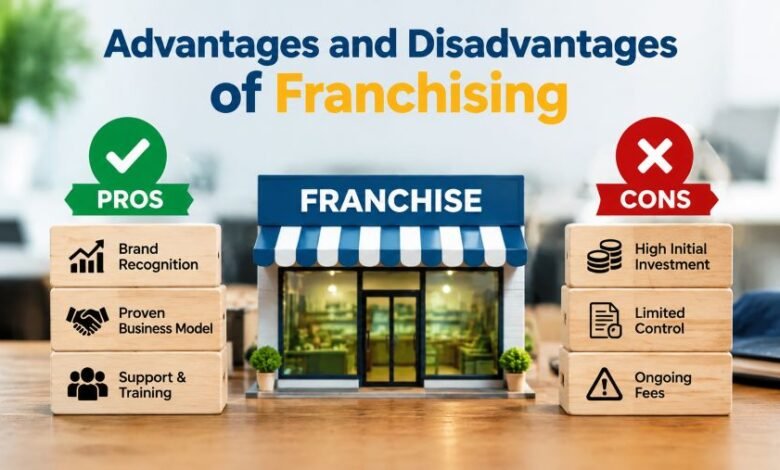
Advantages and Disadvantages of Franchising at a Glance
| Advantages of Franchising | Disadvantages of Franchising |
|---|---|
| Established brand recognition | Limited business freedom |
| Proven business system | Franchise and royalty fees |
| Training and ongoing support | High initial investment |
| Marketing assistance | Contract restrictions |
| Supplier relationships | Less opportunity for creativity |
| Lower uncertainty than starting alone | Dependence on franchisor decisions |
What Is Franchising?
Franchising is a business arrangement where one company allows another person or business to use its brand name, products, and operating system.
The company providing the rights is called the franchisor.
The person buying the rights is called the franchisee.
The franchisee operates the business according to the franchisor’s standards while paying agreed fees.
These fees may include:
- Initial franchise fee
- Royalty payments
- Marketing contributions
- Service charges
The U.S. Small Business Administration (SBA) explains that franchising can provide entrepreneurs with a recognised business structure while still requiring careful planning and financial evaluation. (SBA)
Advantages of Franchising
1. Immediate Brand Recognition
Building a brand takes time.
A new business may spend years convincing customers to trust its name.
A franchise starts differently.
Customers already recognise the brand.
They understand the products. They know what experience to expect.
This advantage can make customer acquisition easier during the early stages.
For example, someone opening a McDonald’s franchise benefits from decades of worldwide brand recognition instead of building a restaurant identity from scratch.
Brand familiarity can become a powerful business advantage.
2. A Proven Business Model
Many new businesses fail because owners are still testing what works.
A franchise removes much of that uncertainty.
The franchisee receives an established system covering:
- Operations
- Customer service
- Product standards
- Marketing methods
- Employee procedures
The owner does not need to invent every process.
They follow a roadmap.
This does not mean success is automatic.
Good management still matters.
3. Training and Business Support
A first-time business owner may understand the idea of running a company but struggle with daily operations.
Franchise support can fill that gap.
Many franchisors provide:
- Initial training
- Staff guidance
- Operating manuals
- Marketing support
- Technology assistance
This support network can make the learning curve easier.
4. Stronger Marketing Power
Marketing is expensive.
A small independent business may struggle to compete with large companies.
Franchise owners often benefit from wider advertising campaigns created by the main brand.
Support may include:
- National promotions
- Brand campaigns
- Social media materials
- Marketing strategies
The franchisee gets access to resources that would normally require a much larger budget.
5. Established Supplier Network
A franchise network usually has existing supplier relationships.
This can help owners access:
- Reliable products
- Standardised quality
- Better purchasing systems
- Efficient distribution
An independent business often needs years to build similar connections.
6. Easier Customer Trust
Trust is one of the hardest things for a new business to create.
A recognised franchise brand already carries customer expectations.
People may feel more comfortable buying from a company they already know.
This can provide an advantage in competitive markets.
Disadvantages of Franchising
1. Less Control Over Business Decisions
This is the biggest complaint among many franchise owners.
Entrepreneurs often want independence.
Franchising provides ownership, but within a system.
Owners may need approval for changes involving:
- Products
- Branding
- Store design
- Suppliers
- Marketing
The franchise model protects consistency, but it can limit personal decision-making.
2. High Startup Costs
A franchise is not a cheap shortcut.
Investment requirements can include:
- Franchise purchase fee
- Equipment
- Property costs
- Inventory
- Employee expenses
- Training costs
Popular brands often require significant capital.
Before investing, entrepreneurs should calculate total costs, not only the franchise fee.
3. Ongoing Fees Reduce Profit
Franchise owners usually share revenue with the franchisor.
Common payments include:
- Royalty fees
- Advertising fees
- Service charges
These payments provide support and brand access.
But they also reduce the profit kept by the owner.
4. Limited Creativity
Some entrepreneurs love creating new ideas.
Franchising may feel restrictive.
A franchise owner usually cannot freely:
- Change products
- Create new branding
- Modify business systems
- Introduce major changes
The same rules that create consistency can limit innovation.
5. Reputation Depends on the Entire Brand
A franchise owner’s reputation is connected to the larger company.
A problem at another location can influence customer opinions everywhere.
One poor-performing branch may affect the public image of the entire network.
6. Strict Franchise Agreements
Franchise contracts often contain detailed requirements.
These may cover:
- Operating standards
- Territory rights
- Renewal conditions
- Supplier rules
- Brand protection
Reading the agreement carefully is essential before signing.
Real Examples of Franchise Businesses
McDonald’s
McDonald’s is one of the world’s most recognised franchise businesses.
Its franchise model allows independent operators to run restaurants using the company’s brand, systems, and operational standards.
Anytime Fitness
Anytime Fitness uses franchising to expand fitness centres across different markets.
Franchise owners benefit from an established fitness concept and support structure.
Kumon
Kumon operates through a franchise model focused on education services.
It allows entrepreneurs to run learning centres using Kumon’s established teaching system.
Who Should Choose Franchising?
Franchising may be suitable for people who:
- Want a structured business model
- Prefer guidance over complete independence
- Value an established brand
- Are comfortable following systems
- Have enough investment capital
It may not suit people who:
- Want complete creative control
- Prefer building their own brand
- Dislike business rules
- Want unlimited flexibility
The right choice depends on personality, goals, and financial situation.
Franchising vs Independent Business
| Factor | Franchise | Independent Business |
|---|---|---|
| Brand | Already established | Must be created |
| Support | Available | Limited |
| Rules | More restrictions | Full freedom |
| Startup process | Structured | Created by owner |
| Creativity | Lower | Higher |
| Risk | Reduced in some areas | Often higher |
Advantages of Franchising for Companies
Franchising also helps companies grow.
Faster Expansion
Companies can open more locations without personally financing every branch.
Franchise owners provide investment and manage daily operations.
Wider Market Reach
More franchise locations help brands enter new regions and reach more customers.
Shared Business Responsibility
Daily management is handled by franchise partners, reducing some operational pressure.
Disadvantages of Franchising for Companies
Quality Control Challenges
Maintaining the same standards across many locations can be difficult.
Every franchise must represent the brand properly.
Franchise Conflicts
Disagreements can happen over:
- Fees
- Business strategies
- Marketing decisions
- Operational rules
Brand Reputation Risk
A single poorly managed location can affect the reputation of the entire company.
Is Franchising Worth It?
Franchising is not a guaranteed path to success.
It is a business model with advantages and limitations.
For some entrepreneurs, the support, brand recognition, and proven system make franchising an excellent opportunity.
For others, the restrictions and fees may feel too limiting.
The key question is simple:
Do you want to build everything yourself, or do you prefer using a system that already exists?
That answer often decides whether franchising is the right choice.
Frequently Asked Questions
What is the biggest advantage of franchising?
The biggest advantage is access to an established brand, proven system, and business support.
What is the biggest disadvantage of franchising?
The biggest disadvantage is reduced independence because franchise owners must follow franchisor rules.
Is franchising safer than starting a new business?
It can reduce some risks because the business model is already developed, but success is never guaranteed.
Do franchise owners own the brand?
No. They receive permission to use the brand while operating under a franchise agreement.
Why do companies use franchising?
Companies use franchising to expand faster and enter new markets with support from franchise partners.
Looking for more business ideas before choosing your next opportunity? Explore practical options for starting and growing a business.
References
- Federal Trade Commission (FTC) — A Consumer’s Guide to Buying a Franchise
- U.S. Small Business Administration (SBA) — Buying an Existing Business or Franchise
- American Express Business Insights — Advantages and Disadvantages of Franchising
- International Franchise Association (IFA) — Pros and Cons of Buying a Franchise