Last Updated on October 20, 2026 by Business Blog Media Editorial Team
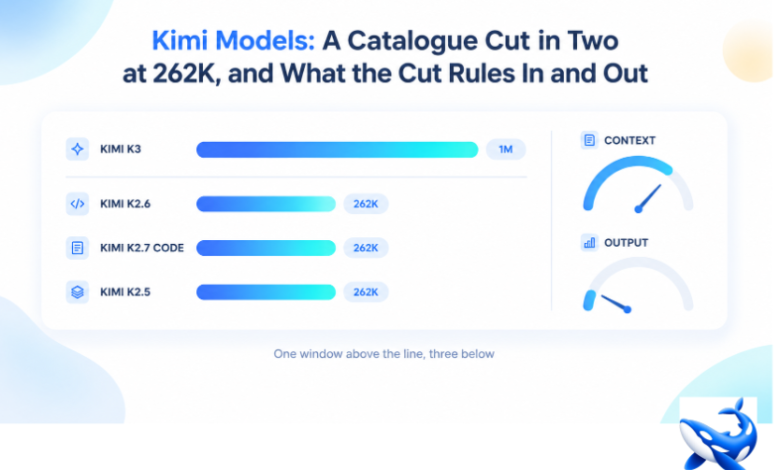
A single column cuts the OrcaRouter Kimi models catalogue in two: Kimi K3 carries a 1M context window, while kimi/kimi-k2.6, Kimi K2.7 Code and kimi/kimi-k2.5 all stop at 262K. One model above the line, three below it, and no row in between.
That cut is not a detail in a specification table. It is the line along which two different kinds of work get sorted, and it is drawn inside a vendor family rather than between vendors — which makes it the kind of constraint a reader is likely to miss, because the model names, the prefix and the price ladder all look continuous until you reach the context column.
The cut, in one table
Four rows is short enough to read in full.
| Model | Input /M | Output /M | Context | Max output | Quality |
| Kimi K3 | $3.00 | $15.00 | 1M | — | 9 |
| kimi/kimi-k2.6 | $0.950 | $4.00 | 262K | 32K | 8 |
| Kimi K2.7 Code | $0.950 | $4.00 | 262K | 262K | 8 |
| kimi/kimi-k2.5 | $0.600 | $3.00 | 262K | 32K | 7 |
Two observations fall out of reading the columns together rather than one at a time. First, the price ladder does not follow the context ladder. The cheapest row on the page is kimi/kimi-k2.5 at $0.600 per million input tokens — that is the page’s cheapest-input statistic — and it is one of the three rows below the line. K3, the only row that reaches 1M, is $3.00 per million input and $15.00 per million output. So the model with the widest window costs five times the cheapest row on input and five times on output, and a reader who sorts by price will land on the wrong side of the cut.
Second, the max-output column does not track the context column either. Two of the three 262K rows cap their output at 32K — kimi/kimi-k2.6 and kimi/kimi-k2.5 — while Kimi K2.7 Code, at the same 262K context and the same $0.950 / $4.00 rate as k2.6, is listed with a 262K max output. Two rows, identical on price, identical on window, and roughly eight times apart on the ceiling that decides how much the model can write back in one call.
The quality column here is our own 0-to-10 composite, built from our own quality dimensions across the catalogue; it is our measurement, not a third-party benchmark, and it is coarse by design — it separates the four rows into three tiers without pretending that two rows sharing a digit are interchangeable.
What 262K holds, and what it does not
Take 262K as roughly a quarter of a million tokens. That is a large working set by any historical standard and it is comfortably enough for document-scale work: a long contract with its annexes, a support ticket thread with attachments, a research dossier assembled from several sources, a full day of an application log. Those jobs fit, they run, and the three cheaper rows are the sensible place to run them.
Repo-scale work is where the ceiling bites, and it bites in a way that has nothing to do with how much the model understands. A single request can only carry what fits in the window. If your prompt is the entire source tree of a mid-sized repository plus the diff plus the instructions, the request either shrinks to fit or it fails, and neither outcome is a prompt-engineering problem you can style your way out of. You get one of two behaviours: a truncated prompt that silently drops files from the end of your packing order, or a hard limit you discover in production.
That is the practical meaning of the cut. Below the line, the size of the material you can hand a model in one call is bounded by a quarter of a million tokens, and the engineering work concentrates on packing — retrieval, ranking, summarising what you leave out, deciding which files earn a slot. Above the line, at 1M, that same packing work still exists but the threshold at which it becomes mandatory moves roughly four times further out, and the jobs that simply do not fit below the line become the ordinary case above it.
The output cap is a second ceiling
A context window is the ceiling on what goes in; the max-output column is the ceiling on what comes back, and the second ceiling is the one teams forget to check until a run fails halfway through.
Thirty-two thousand tokens of output is a lot of prose — a long document, a substantial patch, a detailed report — and for summarisation, extraction, classification or a small edit, you will never approach it. Where it stops being generous is any job whose answer is itself the whole artefact: a full-file rewrite returned in one call, a long generated document with no continuation pass designed into the pipeline, a structured output that has to be complete and valid in a single response. In those jobs the ceiling becomes a design constraint, and the design answer is continuation — chunk the output, stitch the parts, make the pipeline tolerant of a response that ends at the limit rather than failing on it.
The pair of numbers is worth remembering together because they are easy to confuse. kimi/kimi-k2.6 and kimi/kimi-k2.5 read 262K / 32K: a wide input and a comparatively narrow return. Kimi K2.7 Code reads 262K / 262K, and that pairing — an output ceiling equal to the context window — is what makes it a code row rather than a general one, because a code answer often has to be a complete file.
Two ways the page writes one window
One convention deserves a sentence before you quote any of this. The Kimi page’s FAQ answers the largest-context question with 1048K tokens, naming Kimi K3; the pricing table’s own context column for the same model reads 1M. Those are two spellings of the same window on one page, not two measurements, and this article quotes the table — 1M — because that is the column a reader scanning the catalogue actually sees. Do not put 1048K and 1M into the same sentence as though they were a contradiction; they are not, and the page does not claim they are.
The mechanics around the catalogue are the ordinary ones: every row is called through one OpenAI-compatible key, the models are referenced as kimi/<model>, and the base_url is https://api.orcarouter.ai/v1. The prices above are the provider’s published rates, passed through with $0 markup, which is why comparing them across providers stays meaningful.
The takeaway
A four-row catalogue with one 1M window and three 262K ceilings is a catalogue with an internal decision already made for you: the long-context job and the short-context job live in different rows, and the cheap rows are the short ones. Nothing about that is a defect. It is a shape, and shapes are readable.
Read the shape before you price the work. Document-scale tasks, summarisation, extraction, bounded edits — the three rows below the line do all of it, at a floor of $0.600 per million input tokens. Repository-scale prompting and any job whose answer must come back complete in one call need the model above the line, or a pipeline designed around the ceiling below it — chunked retrieval in, continuation out, and a plan for the request that would otherwise be truncated.
The mistake the cut invites is the quiet one: picking a row on price, writing the integration, and discovering the ceiling at the first payload large enough to hit it. The column is on the page. Read it before you write the prompt.
Sourcing note: the four models, their input and output rates, context windows, max-output ceilings and the cheapest-input statistic are from the OrcaRouter Kimi provider page, read 2026-10-14 [OURS]. The rates themselves are the vendor’s published rate card, passed through with $0 markup [VENDOR]. The 0-to-10 quality scores are our own composite, built from our own quality dimensions across the catalogue, and are not a third-party benchmark. The 1048K figure quoted in the FAQ section is the vendor’s own rounding of the same window; the table writes it as 1M, and this article quotes the table. No [INDEPENDENT] third-party figures are used. All figures checked 2026-10-14.