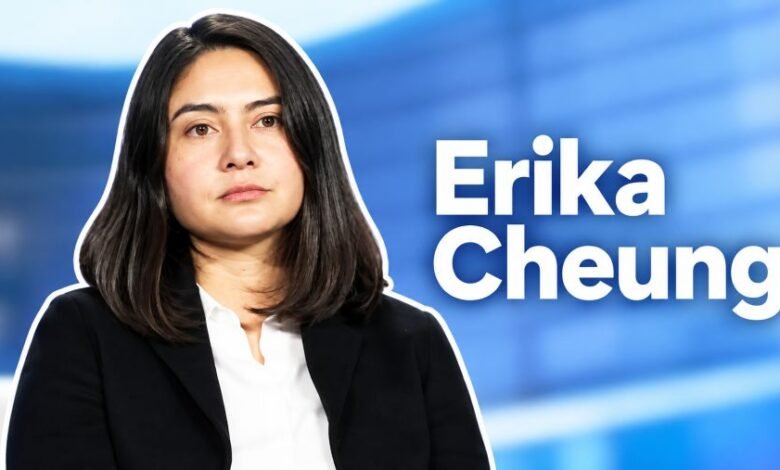
Erika Cheung: From Theranos Lab Worker to Ethics Advocate
The former Theranos employee became one of the best-known whistleblowers in the case. Her work now focuses on ethics, responsible technology and people who speak up against wrongdoing.

Last Updated on September 19, 2026 by Business Blog Media Editorial Team
Introduction
Erika Cheung became known worldwide for one difficult decision: she spoke up.
She was a young laboratory worker at Theranos. The company looked exciting from the outside. Inside the lab, though, she began seeing problems that made her question whether its blood-testing technology could produce reliable results.
She raised those concerns. Then she left.
What happened next put her at the centre of one of Silicon Valley’s most famous corporate scandals. She contacted regulators, helped journalists understand what was happening inside Theranos and later testified in the criminal trial of founder Elizabeth Holmes.
Her career did not end with Theranos. Far from it. She later worked with startups in Asia, helped build an accelerator in Hong Kong and started an organisation focused on ethics in business and emerging technology.
Quick Facts About Erika Cheung
| Fact | Details |
|---|---|
| Full name | Erika Cheung |
| Known for | Theranos whistleblowing |
| Education | University of California, Berkeley |
| Areas studied | Molecular and Cell Biology and Linguistics |
| Former employer | Theranos |
| Time at Theranos | About seven months |
| Later startup work | Founding team member at Betatron |
| Organisation | Ethical Crossroads, formerly Ethics in Entrepreneurship |
| Current work | Business ethics, emerging technology, whistleblower advocacy |
| Public speaking | TED speaker and conference speaker |
| Other interests | Mixed martial arts |
Early Life and Education
Cheung grew up in California.
Her own website says her family shared a one-bedroom trailer during part of her childhood. She was homeschooled and started community college when she was 14. Those details give some context to the path she later took. It was not a standard one.
She went on to study at the University of California, Berkeley.
Her academic interests were quite different from each other. She studied Molecular and Cell Biology alongside Linguistics. Berkeley’s alumni organisation identifies her as part of the Class of 2013, while her current personal website lists graduation in 2012. Because those public sources differ, the exact graduation year should be treated carefully.
Science soon became her professional path.
How Erika Cheung Joined Theranos
Theranos looked like a dream opportunity.
Cheung came across the company through a Berkeley job fair in 2013. She was a senior studying cell biology and linguistics at the time. She later told Berkeley’s alumni publication that she was 22 and could imagine staying with the company for ten years.
The promise sounded huge.
Theranos claimed it could change medical testing by running blood tests using very small samples. That idea appealed strongly to a young scientist interested in healthcare.
She joined after college.
It was her first job after university.
But the excitement faded quickly.
What She Saw Inside Theranos
Cheung worked in the Theranos laboratory for roughly seven months.
During that period, she became concerned about the performance of the company’s testing systems and the way laboratory quality checks were handled.
Those concerns mattered because real patient samples were involved.
She later described problems with quality-control results and questioned whether Theranos’s technology was ready for the kind of clinical use the company was promoting.
This was not an easy position for a young employee.
Theranos had wealthy investors, powerful board members and enormous media attention. Cheung was near the start of her career.
Still, she kept asking questions.
Berkeley’s alumni organisation describes her as one of the main whistleblowers who helped expose problems at the company. Stanford also describes her as one of the people who reported the Theranos case to regulators.
Raising Concerns Inside the Company
She first tried internal channels.
Cheung questioned laboratory practices and raised concerns with people inside Theranos. Her doubts did not disappear.
That became the breaking point.
She eventually decided to leave the company after about seven months. Leaving solved one problem — she was no longer working inside a lab she did not trust — but it created another.
What should she do with what she knew?
She chose to speak.
Becoming a Theranos Whistleblower
Cheung became one of the central former employees connected with the exposure of Theranos.
She spoke with journalist John Carreyrou, whose reporting for The Wall Street Journal became a major part of the public examination of the company.
Another former employee, Tyler Shultz, also raised concerns.
The whistleblowers faced serious pressure. Speaking against a company with money, lawyers and influential supporters carried obvious personal and professional risks.
Cheung still went further.
In 2015, she reported concerns to federal health regulators.
That decision made her role far more than an internal employment dispute. Regulators could now examine the laboratory practices themselves.
TED later described her as one of the key whistleblowers in the Theranos scandal.
Why the Theranos Case Became So Serious
Theranos was not a small startup by this point.
It had attracted huge amounts of investor money while promoting technology that was supposed to change blood testing.
In March 2018, the U.S. Securities and Exchange Commission charged Theranos, Elizabeth Holmes and former company president Ramesh “Sunny” Balwani with fraud-related violations.
The SEC said Theranos had raised more than $700 million from investors while making false or exaggerated statements about its technology, business and financial performance. The SEC also said the company’s proprietary analyser could perform only a limited number of tests while many patient tests were run using modified or standard commercial machines.
That official action backed up the wider concerns surrounding Theranos.
The company eventually collapsed.
Testifying in the Elizabeth Holmes Case
Cheung later became a witness in the federal criminal case against Elizabeth Holmes.
Her experience mattered because she had worked directly inside the laboratory.
She could explain what employees saw, what concerns were raised and how testing worked during her time there.
Holmes’s criminal trial lasted about 15 weeks.
On January 3, 2022, a federal jury found Holmes guilty of one count of conspiracy to commit fraud against investors and three counts of wire fraud involving investors. She was acquitted on the patient-related conspiracy count and three patient fraud counts.
That distinction matters.
Cheung’s whistleblowing played an important part in exposing concerns around Theranos, but it would be inaccurate to say her testimony alone produced Holmes’s convictions.
In November 2022, Holmes received a federal prison sentence of 135 months, equal to 11 years and three months.
Life After Theranos
Cheung did not build the rest of her career around one scandal.
She moved into startup and investment work.
Her personal timeline says she moved to Hong Kong in 2016, where she worked on links between startup communities in the United States and Asia.
She became part of the founding team behind Betatron, a Hong Kong startup accelerator.
TED also credits her with helping launch Betatron and working to grow startup activity in Hong Kong and across Asia.
That experience gave her another view of how young companies operate.
Big ideas can move quickly. Money can move quickly too. Internal safeguards do not always keep pace.
Those questions became central to her next project.
Ethics in Entrepreneurship
Cheung later co-founded Ethics in Entrepreneurship.
The nonprofit was set up to help founders, workers and investors think more clearly about ethical problems before they become major crises.
The idea came directly from experience.
What happens when an employee sees something wrong?
Who can they tell?
What happens when company culture makes disagreement dangerous?
And what systems can businesses put in place before those problems appear?
Stanford has described her as the executive director of Ethics in Entrepreneurship and an adviser to family offices, venture capital firms and investment programmes working in healthcare, biotechnology and biosciences.
Ethical Crossroads
Her work has since expanded.
Cheung’s current website presents the organisation as Ethical Crossroads, formerly Ethics in Entrepreneurship. She lists herself as its Executive Director and Co-Founder.
The nonprofit focuses on helping founders and emerging-technology companies deal with hard ethical decisions.
That now includes questions around AI ethics, AI safety, technological risk and biosecurity.
This is an important part of her present career.
She is no longer speaking only about what went wrong at Theranos. She is using that experience to talk about how organisations can spot dangerous decisions earlier.
Whistleblower Advocacy
Cheung remains involved with whistleblower support.
Whistleblowers of America currently lists her on its board of directors and identifies her with ethics and entrepreneurship work.
Her work in this area looks at the problems employees can face after reporting misconduct.
Retaliation can hurt careers. Legal pressure can be expensive. Social pressure matters too.
She now speaks publicly about those issues and works with groups that support people who report wrongdoing.
TED Talk and Public Speaking
Her Theranos story reached another large audience through TED.
In 2020, she gave the talk “Theranos, whistleblowing and speaking truth to power.”
The talk has received more than 2.7 million plays on TED’s website. In it, she discusses the personal difficulty of speaking up and the pressures that can stop people from acting even when they believe something is wrong.
She has since appeared at universities, business events and technology conferences.
Stanford hosted her in April 2025 as part of its Entrepreneurial Thought Leaders Speaker Series. The university described her work around startup ethics, healthcare, biotechnology and the lessons learned from Theranos.
Erika Cheung and The Dropout
The Theranos story moved well beyond business news.
It became the subject of books, documentaries, podcasts and television dramas.
Cheung’s role appeared in coverage surrounding John Carreyrou’s Bad Blood and the HBO documentary The Inventor: Out for Blood in Silicon Valley.
Her character was also included in Hulu’s drama series The Dropout, which told the story of Holmes and Theranos.
This brought Cheung’s story to people who had never followed the original laboratory scandal.
Personal Interests
Cheung keeps much of her personal life outside public discussion.
That boundary matters.
Reliable public sources do not clearly establish her current relationship status, spouse, children, exact birth date, height or personal net worth. Those details should not be guessed.
One personal interest she has discussed publicly is mixed martial arts.
Whistleblowers of America describes her as an avid mixed martial artist. She has also expressed interest in supporting efforts that use martial arts to help trauma survivors.
What Is Erika Cheung Doing Now?
As of September 2026, Cheung’s public work remains centred on ethics, whistleblower advocacy and responsible development of new technology.
Her current website identifies three parts of her professional identity: whistleblower, founder and speaker.
Ethical Crossroads is a main part of that work.
She also continues to discuss AI safety, biosecurity and the risks that appear when companies move faster than their ability to check their own decisions.
Her connection with Theranos will always be the part of her career most people recognise.
But it is not the whole story.
Final Thought
Erika Cheung entered Theranos as a young scientist looking for meaningful work.
Seven months changed her path.
She questioned laboratory practices, left the company and reported what she had seen. Years later, those experiences put her inside courtrooms, documentaries, university events and conversations about corporate ethics.
Now her work asks a wider question.
How can people speak up before bad decisions grow into public harm?
That question connects her early laboratory experience with the work she does today.
Frequently Asked Questions
Who is Erika Cheung?
Erika Cheung is a former Theranos laboratory employee, whistleblower, entrepreneur and ethics advocate.
Why is Erika Cheung famous?
She became widely known after raising concerns about Theranos’s blood-testing practices and reporting the company to regulators.
Did Erika Cheung work at Theranos?
Yes. She worked in the Theranos laboratory for about seven months after college.
Where did Erika Cheung study?
She studied Molecular and Cell Biology and Linguistics at the University of California, Berkeley.
Did Erika Cheung testify against Elizabeth Holmes?
Yes. She testified during the federal criminal trial concerning Holmes and Theranos.
What does Erika Cheung do now?
Her current public work covers ethical business decisions, whistleblower advocacy, emerging technology, AI-related risk and biosecurity.
What is Ethical Crossroads?
Ethical Crossroads is the organisation formerly known as Ethics in Entrepreneurship. It works with people and companies facing difficult ethical decisions.
Is Erika Cheung married?
Reliable public sources reviewed for this article do not establish her current marital status, so the article does not make a claim about it.