David Harding: The Scientist Who Built Winton
How a Cambridge physics graduate helped shape systematic investing and later supported science, education and public understanding

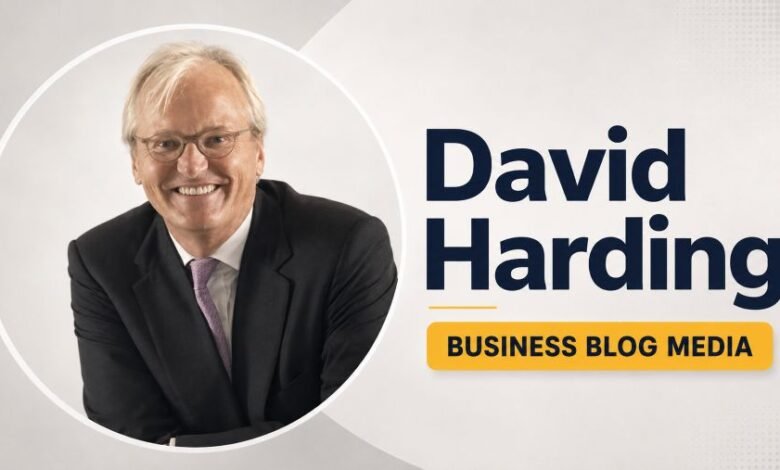
Last Updated on July 28, 2026 by Business Blog Media Editorial Team
Introduction
Sir David Harding is a British investment manager, entrepreneur and philanthropist. He is best known for founding Winton, a global investment company that uses mathematics, statistics and computer-based research to study financial markets.
Before Winton, he co-founded Adam, Harding & Lueck, better known as AHL. The company became an important early name in systematic investment management and was sold to the organisation that later became Man Group.
As of July 2026, Harding is the Founder and Chair of Winton. He is no longer correctly described as the company’s chief executive. His official Winton leadership profile confirms his current position.
Harding is also known for supporting universities, scientific research and public education. He received a knighthood in 2022 for services to philanthropy.
David Harding Quick Facts
| Fact | Verified information |
|---|---|
| Full professional name | Sir David Winton Harding |
| Born | August 1961 |
| Nationality | British |
| Profession | Investment manager, entrepreneur and philanthropist |
| Best known for | Founding Winton and co-founding AHL |
| Current position | Founder and Chair of Winton |
| Winton founded | 1997 |
| Education | Natural Sciences at the University of Cambridge |
| Academic specialisation | Theoretical physics |
| Major honour | Knight Bachelor |
| Reason for knighthood | Services to philanthropy |
| Main business field | Systematic and quantitative investment management |
Public company records confirm that his registered name is David Winton Harding, that he was born in August 1961 and that he remains an active director of Winton Group Limited.
Who Is David Harding?
David Harding is an investment manager who uses scientific thinking to study financial markets.
Many traditional investors make decisions by meeting company leaders, reading financial reports or judging the direction of the economy. Harding became known for a different method.
His companies developed computer-based systems that examined large amounts of market information. These systems searched for patterns that could help guide investment decisions.
This type of work is often called quantitative or systematic investing.
Harding did not create the entire field, but he became one of its important British business figures. His work helped show that scientific research, statistics and computer technology could become central parts of professional investment management.
David Harding’s Education
Harding studied Natural Sciences at St Catharine’s College, part of the University of Cambridge.
He graduated in 1982 with first-class honours. His main academic specialisation was theoretical physics.
Theoretical physics uses mathematics to understand how natural systems behave. Although financial markets are different from the physical world, the course gave Harding useful skills in:
- Mathematical reasoning
- Testing ideas
- Studying complicated systems
- Working with uncertain information
- Examining large amounts of data
- Separating evidence from opinion
He later brought many of these ideas into investment management.
However, he has also explained that markets cannot be treated exactly like physics. The laws of nature do not change because people learn about them, but financial markets can change when investors alter their behaviour.
His Early Financial Career
After completing his studies, Harding entered the financial industry.
His early work introduced him to stockbroking, futures markets and commodity trading. Futures are financial contracts connected with assets such as currencies, interest rates, agricultural goods and stock-market indexes.
During the 1980s, computers were becoming more useful in financial businesses. They could process information faster than individual traders and test investment ideas across many years of historical market data.
Harding recognised that this technology could support a more organised investment process.
Instead of depending only on feelings or predictions, a company could create clear rules, test those rules and examine whether they continued to work.
How Did David Harding Start AHL?
In 1987, Harding co-founded Adam, Harding & Lueck with Michael Adam and Martin Lueck.
The business became widely known by its initials, AHL.
AHL developed systematic trading strategies for futures markets. Its computer models examined price movements and other market information before producing trading signals.
One important approach was trend following.
Trend-following systems try to identify when the price of an asset is moving strongly in one direction. A system may follow an upward movement or respond to a downward movement while using rules to control risk.
The strategy does not require someone to know the exact reason for every price movement. It focuses on what market data is showing.
AHL became an important business in this developing area of finance. ED&F Man purchased an initial controlling interest and completed its acquisition of the company in 1994.
The business later became part of Man Group and continued operating under the AHL name.
Why Did David Harding Create Winton?
Harding left Man Group and started Winton in 1997.
He wanted to build an investment company with research at the centre of its work.
Winton began trading in October 1997 from a small office in Kensington, London. It started with approximately $1.6 million in assets and only two employees.
The company’s name came from Harding’s middle name, Winton.
Its early investment method used systematic trend following, an approach he had already helped develop at AHL. However, the new company continued researching additional ideas and improving its models.
Harding recruited scientists and researchers who could study difficult information. Some came from backgrounds outside traditional banking and investment management.
This hiring approach was unusual because financial companies normally looked mainly for people with experience in economics, banking or trading.
Winton instead searched for people who understood mathematics, statistics, computing and scientific testing.
How Does Systematic Investing Work?
Systematic investing follows a defined process.
A research team first develops an idea about how markets may behave. It then studies historical information to see whether the idea has worked in different periods.
A simple process may include:
- Collecting reliable market data
- Finding a possible pattern
- Creating clear investment rules
- Testing those rules using past information
- Checking how much risk the strategy creates
- Studying whether the result could have happened by chance
- Using the system in real markets
- Continuing to review and improve it
A model is not a machine that can predict the future perfectly.
Unexpected events, changing behaviour and new market conditions can cause a strategy to perform differently from its historical results.
For this reason, quantitative investment managers normally use risk controls and more than one type of strategy.
How Winton Grew
Winton grew from a two-person startup into an international investment-management company.
Its development was supported by several factors:
- Greater computing power
- Improved access to market data
- Growing institutional interest in quantitative investing
- A large research team
- Careful statistical testing
- Expansion into different asset classes
- Continued development of investment models
The company has worked with major institutional clients, including pension funds and other professional investors.
Winton’s strategies have developed beyond its original trend-following system. Its teams research different markets and use multiple types of financial signals.
The company has offices and business operations in major financial centres.
What Is David Harding Doing Now?
As of July 2026, Harding is Winton’s Founder and Chair.
He remains an active director of Winton Group Limited and Winton Capital Management Limited.
The title “Founder and Chair” is important.
Some older articles and profiles describe him as Winton’s chief executive. Those descriptions reflect earlier stages of his career and should not be presented as his current role.
As Chair, his work is connected with the company’s direction, ownership and long-term development rather than every part of its daily management.
How David Harding Changed Investment Management
Harding’s career helped strengthen the connection between science and finance.
His business approach placed importance on:
- Evidence rather than personal confidence
- Statistical testing rather than attractive stories
- Research rather than short-term market predictions
- Risk control rather than unlimited return targets
- Specialist teams rather than one famous investment manager
- Continuous learning rather than fixed ideas
His method also shows the importance of doubt.
A responsible researcher must consider whether an apparent pattern is real or simply appeared by chance. This is especially important when computers can test thousands of possible ideas.
A model that looks excellent in past data may fail in real conditions when it was designed too closely around historical results.
Harding’s public discussions have therefore focused not only on the power of data but also on its limitations.
David Harding and Financial Technology
Harding’s companies were using computers in finance long before smartphones, digital banks and modern artificial intelligence became common.
However, systematic investment management is different from consumer financial technology.
Winton mainly develops investment strategies for professional clients. Consumer fintech companies usually build services for payments, borrowing, banking, insurance or personal savings.
The wider financial industry includes many different founder journeys. A technology entrepreneur who became an early-stage investor may concentrate on supporting new software companies, while Harding’s main work has centred on research-led investment systems.
Similarly, a financial-services founder making pensions simpler shows how digital tools can improve services used directly by ordinary savers.
These businesses are different, but they share an important idea: technology should solve a clear financial problem rather than exist without a useful purpose.
David and Claudia Harding’s Philanthropy
Harding carries out important charitable work with his wife, Claudia Harding.
Their support mainly focuses on:
- University students
- Scientific research
- Mathematics
- Physics
- Public understanding of risk
- Medical and biological research
- Science communication
In February 2019, the David and Claudia Harding Foundation announced a £100 million gift to the University of Cambridge and St Catharine’s College.
Cambridge described it at the time as the largest single gift made to a UK university by a British philanthropist.
The funding supported postgraduate scholars, undergraduate financial assistance and programmes designed to encourage wider student-support donations.
The Harding Scholars Programme
Part of the Cambridge gift created the Harding Distinguished Postgraduate Scholars Programme.
The programme supports PhD students from the United Kingdom and other countries.
Doctoral research can take several years and may require funding for:
- University fees
- Living costs
- Research materials
- Academic travel
- Specialist equipment
- Conferences and professional development
Scholarship support can allow researchers to concentrate on their work without facing the same level of financial pressure.
The wider donation also supported undergraduate students who needed financial assistance.
Support for Physics and Mathematics
Harding has funded research connected with physics, sustainability and the public understanding of statistics.
A major donation supported the Winton Programme for the Physics of Sustainability at Cambridge’s Cavendish Laboratory.
The programme explored how physics could help researchers understand difficult questions involving natural resources, energy and sustainable technology.
David and Claudia Harding also supported the Science Museum’s Mathematics: The Winton Gallery in London.
The gallery explains how mathematics affects transport, engineering, trade, technology and ordinary life.
Their support reflects Harding’s wider belief that scientific ideas should not remain understandable only to specialists.
Understanding Risk
One of Harding’s important charitable interests is helping people understand risk.
Risk affects many parts of life, including:
- Health decisions
- Medical treatments
- Insurance
- Investing
- Public policy
- News reports
- Environmental planning
- Personal finance
Numbers can be technically correct but still presented in a confusing way.
For example, describing a risk as doubling may sound frightening. However, the practical meaning is very different when a risk rises from one person in a million to two people in a million rather than from one person in ten to two people in ten.
Supporting clear risk communication can help the public make better decisions.
Why Was David Harding Knighted?
Harding was made a Knight Bachelor in the 2022 New Year Honours.
The official honour stated that it was awarded for services to philanthropy.
The honour recognised his support for education, research and public understanding.
After receiving a knighthood, his formal name became Sir David Harding.
What Can Entrepreneurs Learn From David Harding?
Build Around a Clear Strength
Harding understood scientific research and quantitative reasoning.
Instead of copying a traditional investment company, he built a business around those strengths.
Test Ideas Before Trusting Them
An idea may sound intelligent but still fail when tested.
Entrepreneurs should use evidence, customer feedback and real results before making large decisions.
Hire People With Different Knowledge
Winton recruited scientists as well as financial specialists.
A team can solve more difficult problems when its members bring different skills and ways of thinking.
Begin Small
Winton started with two employees and approximately $1.6 million under management.
A business does not need to begin with a large office or hundreds of workers. It needs a useful idea, a workable system and enough resources to test the model.
Continue Improving
A strategy that worked in the past may not work forever.
Businesses must study changing technology, customer behaviour, competition and economic conditions.
Understand Risk
Growth creates opportunity, but it also creates danger.
Strong companies study what could go wrong and prepare before a problem becomes too large.
Use Success for Wider Benefit
Harding later directed part of his financial success towards students, universities, museums and scientific research.
His charitable work shows how business wealth can support projects with long-term public value.
Interesting Facts About David Harding
- His middle name, Winton, became the name of his investment company.
- He studied theoretical physics before entering finance.
- He helped establish two major quantitative investment businesses.
- Winton began with only two employees.
- The company’s starting assets were approximately $1.6 million.
- He recruited scientists to study financial markets.
- He supported a permanent mathematics gallery at London’s Science Museum.
- His foundation gave £100 million to Cambridge and St Catharine’s College.
- His knighthood recognised services to philanthropy rather than investment management.
Frequently Asked Questions
Who is David Harding?
David Harding is a British investment manager, entrepreneur and philanthropist. He is best known for founding Winton and co-founding AHL.
What is David Harding famous for?
He is famous for helping develop systematic investment management, in which statistics, data and computer models guide financial decisions.
What is David Harding’s current role?
As of July 2026, he is the Founder and Chair of Winton.
Is David Harding still the CEO of Winton?
Winton’s current official profile identifies him as Founder and Chair, not chief executive.
What company did David Harding found?
He founded Winton in 1997. He had previously co-founded Adam, Harding & Lueck in 1987.
What does Winton do?
Winton is a quantitative investment-management company. It creates research-based strategies for investing in global financial markets.
Where did David Harding study?
He studied Natural Sciences at St Catharine’s College, University of Cambridge. He specialised in theoretical physics and graduated with first-class honours.
Why is Winton called Winton?
The company was named after Harding’s middle name.
How did Winton begin?
Winton began trading in London in October 1997 with approximately $1.6 million in assets and two employees.
Did David Harding found AHL?
Yes. He co-founded Adam, Harding & Lueck with Michael Adam and Martin Lueck in 1987.
Why was David Harding knighted?
He was knighted in the 2022 New Year Honours for services to philanthropy.
How much did David Harding give to Cambridge?
The David and Claudia Harding Foundation announced a £100 million gift supporting the University of Cambridge and St Catharine’s College in 2019.
Is David Harding involved in philanthropy?
Yes. His charitable support includes university scholarships, student assistance, physics, mathematics, risk communication and scientific research.
Conclusion
David Harding is one of the important figures in British quantitative investment management.
His career began with scientific education rather than a traditional finance degree. He used that background to help create AHL and later founded Winton with a strong focus on evidence, statistics and research.
Winton began as a very small business but developed into an international investment company.
His story also extends beyond financial markets. With Claudia Harding, he has supported students, universities, museums and scientific organisations. Their £100 million Cambridge gift became one of the most significant education donations made by a British philanthropist.
Harding’s career offers a simple business lesson: strong decisions require evidence, careful testing and an honest understanding of risk.