Five Ps of Entrepreneurship: A Practical Guide
Learn how passion, planning, people, profit and perseverance can help an entrepreneur build and improve a business.

Last Updated on August 4, 2026 by Business Blog Media Editorial Team
Introduction
The Five Ps of Entrepreneurship are a practical framework for understanding the main areas involved in building a business.
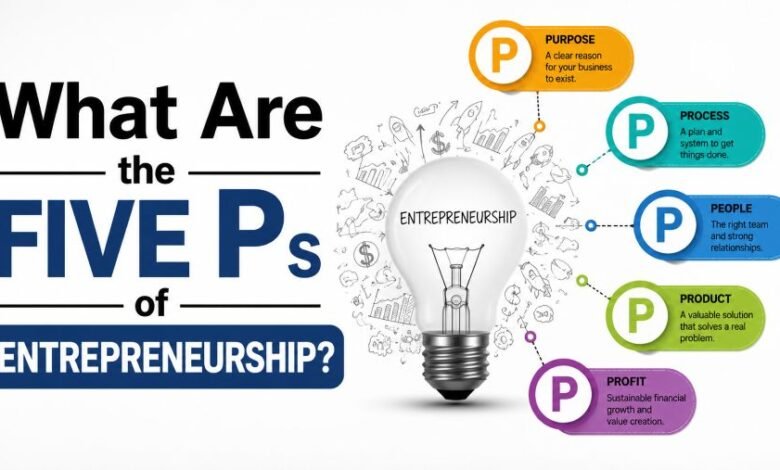
This article uses the following Five Ps:
- Passion
- Planning
- People
- Profit
- Perseverance
Each principle supports a different part of entrepreneurship.
Passion gives the founder motivation. Planning turns the idea into clear actions. People help the business operate and serve customers. Profit supports financial stability. Perseverance helps the entrepreneur continue learning when problems appear.
The Five Ps do not replace market research, financial records or professional advice. They provide a simple checklist that entrepreneurs can use when reviewing a business idea.
Five Ps of Entrepreneurship Quick Guide
| Principle | Meaning | Main Question |
|---|---|---|
| Passion | Strong interest in solving a problem | Why do I want to build this business? |
| Planning | Organising goals, costs and actions | How will the business operate? |
| People | Customers, employees and partners | Who will help the business succeed? |
| Profit | Financial sustainability | Can the business earn more than it spends? |
| Perseverance | Continuing to learn and improve | How will I respond to difficulties? |
What Are the Five Ps of Entrepreneurship?
The Five Ps explain five areas that deserve attention when starting or managing a business.
An entrepreneur may have an exciting idea, but an idea alone is not enough.
The founder must understand the customer, create a useful product or service, organise the work, manage money and respond to changing conditions.
The Five Ps make these responsibilities easier to remember.
They can be used by:
- New entrepreneurs
- Small-business owners
- Freelancers
- Online sellers
- Startup teams
- Family businesses
- Students studying entrepreneurship
A person exploring entrepreneurship can also review these small business ideas from home for beginners.
1. Passion
Passion is a strong interest in an idea, industry or problem.
It often gives an entrepreneur the motivation to begin.
A founder may feel passionate about:
- Improving an existing service
- Helping a particular group of customers
- Creating a useful product
- Solving a local problem
- Turning a skill into a business
- Changing how an industry operates
For example, someone who enjoys repairing bicycles may notice that people in the local area struggle to find affordable repair services.
That interest could develop into a mobile bicycle-repair business.
Passion helps the entrepreneur take the first step, but it must be connected with a real customer need.
Why Passion Matters
Starting a business requires time and attention.
The founder may need to research customers, test products, speak with suppliers, review prices and correct mistakes.
A strong interest in the work can make these responsibilities easier to manage.
Passion can also help an entrepreneur explain the business clearly.
When founders understand why their product matters, they can communicate the idea more confidently to customers, employees and potential partners.
Passion Must Solve a Real Problem
Being interested in an idea does not automatically make it a good business.
Customers must receive something useful.
An entrepreneur should ask:
- What problem does the business solve?
- Who experiences this problem?
- How are people currently solving it?
- Why would they choose this product?
- Are they willing to pay for it?
A founder may love handmade notebooks, but the business still needs customers who value the design, quality or personalisation enough to buy them.
Passion provides energy. Customer demand provides a reason for the business to exist.
How to Test Your Passion
A useful test is to spend time doing the real work before making a large investment.
An aspiring entrepreneur could:
- Speak with potential customers
- Make a basic version of the product
- Offer the service to a small group
- Attend industry events
- Study competitors
- Calculate likely costs
- Work on the idea consistently for several weeks
This process helps separate a lasting business interest from a temporary excitement.
2. Planning
Planning means deciding how the business will move from an idea to practical action.
A business plan does not always need to be a long formal document.
A simple plan can explain:
- What the business sells
- Who the customers are
- Why they may buy
- How the product will be delivered
- How much the business will charge
- What the main costs will be
- How customers will discover the business
- What the founder wants to achieve
The U.S. Small Business Administration explains that market research, competitive analysis, startup costs and business planning are important parts of preparing a business.
Why Entrepreneurs Need a Plan
Planning helps an entrepreneur see weaknesses before spending too much money.
For example, a founder may plan to sell a product for £20.
After calculating materials, packaging, delivery fees, advertising and payment charges, the founder may discover that each sale costs £19.
The original price would leave almost no money for running or growing the business.
Finding this problem during planning is much safer than discovering it after buying a large amount of stock.
What Should a Simple Business Plan Include?
A practical plan can answer these questions:
What are you selling?
Describe the product or service in simple language.
Who is the customer?
Identify the type of person or company most likely to buy.
What problem are you solving?
Explain why the customer needs the product.
Who are the competitors?
Study businesses offering similar solutions.
How will customers find you?
Consider search engines, social media, local advertising, referrals, marketplaces or direct sales.
What will the business cost?
Include startup expenses and continuing costs.
How will the business earn money?
Explain the price, sales model and expected income.
What are the first goals?
Set clear actions for the next month, three months and year.
Planning Is an Ongoing Process
A business plan should change when the entrepreneur receives new information.
Customer feedback may show that people want a different product size.
Sales records may reveal that one service is more popular than another.
A supplier may change its prices.
A competitor may enter the market.
The entrepreneur should review the plan regularly and update it when the evidence changes. Business planning is more useful when it guides continuing decisions instead of becoming a document that is written once and forgotten.
3. People
No business operates completely alone.
Even a one-person company depends on customers, suppliers, delivery services, payment providers and professional advisers.
The People P includes:
- Customers
- Employees
- Co-founders
- Suppliers
- Contractors
- Investors
- Mentors
- Accountants
- Legal advisers
- Business partners
Each group can affect the quality and stability of the business.
Customers Come First
A business exists because customers choose to pay for its products or services.
Entrepreneurs should understand:
- What customers need
- What they can afford
- How they make buying decisions
- What problems frustrate them
- Which features they value
- Why they may choose a competitor
Customer understanding can prevent a founder from building something that nobody wants.
The SBA advises entrepreneurs to identify their target customer and understand the problem that customers are willing to pay to solve.
Building the Right Team
As a business grows, the founder may need help.
The first team members can strongly influence the company’s working culture and customer experience.
Before hiring, the entrepreneur should identify:
- Which work needs to be completed
- Which skills are missing
- Whether the role needs a full-time employee
- Whether a contractor could complete the task
- How much the business can afford
- How performance will be reviewed
Hiring too early can create unnecessary costs.
Hiring too late can place too much pressure on the founder and reduce service quality.
Working With Suppliers
Suppliers provide materials, products, equipment or specialist services.
A reliable supplier can help a company deliver consistent quality.
A poor supplier may cause:
- Late orders
- Damaged products
- Higher costs
- Customer complaints
- Production delays
- Stock shortages
Entrepreneurs should compare suppliers carefully and avoid depending entirely on one provider when practical alternatives are available.
The Value of Partners and Advisers
Entrepreneurs do not need to understand every subject themselves.
An accountant can help organise financial records.
A legal adviser can explain contracts and responsibilities.
A marketing specialist can support customer communication.
A mentor can share experience from similar business challenges.
The founder remains responsible for decisions, but good advice can reduce avoidable mistakes.
The growth of Deliveroo also shows how founders depend on restaurant partners, riders, employees, technology teams and customers. Readers can explore Will Shu and the development of Deliveroo.
4. Profit
Profit is the money remaining after a business pays its expenses.
A simple calculation is:
Revenue − Expenses = Profit
If a company receives £10,000 from sales and spends £8,000 operating the business, its profit before relevant taxes would be £2,000.
Profit allows a business to:
- Replace equipment
- Improve products
- Hire employees
- Manage unexpected costs
- Repay investment
- Build financial reserves
- Expand into new markets
A business may serve an important purpose, but it still needs a workable financial model to continue operating.
Revenue Is Not the Same as Profit
Revenue is the total money received from sales.
Profit is what remains after costs.
A company with high sales can still lose money.
For example:
| Business Activity | Amount |
|---|---|
| Total sales | £50,000 |
| Product costs | £25,000 |
| Staff and contractors | £12,000 |
| Rent and utilities | £7,000 |
| Marketing and other costs | £8,000 |
| Final result | £2,000 loss |
The £50,000 revenue may appear impressive, but the expenses are higher than the income.
Entrepreneurs should monitor both sales and costs.
Understand Startup Costs
Startup costs are the expenses required before or during the early stage of a business.
They may include:
- Equipment
- Stock
- Website development
- Business registration
- Insurance
- Professional services
- Packaging
- Advertising
- Rent deposits
- Software
Calculating these costs helps the founder understand how much money the business needs before it can operate properly.
The SBA guide to planning a business provides tools for market research, business plans, startup costs and funding decisions.
Understand the Break-Even Point
The break-even point is reached when total revenue equals total costs.
At that stage, the business is not producing a profit or a loss.
Knowing the break-even point helps an entrepreneur estimate how many products or services must be sold to cover expenses.
For example, imagine that a business has £1,000 in monthly fixed costs and earns £20 from each sale after direct product costs.
It would need 50 sales to cover the £1,000:
£1,000 ÷ £20 = 50 sales
Sales above that point may begin producing profit, provided other costs do not increase unexpectedly.
Profit and Cash Flow Are Different
A business can appear profitable in its accounts but still experience cash problems.
This may happen when customers receive products immediately but pay invoices several weeks later.
Meanwhile, the company must pay wages, rent and suppliers.
Cash-flow planning helps the entrepreneur understand when money will enter and leave the business.
A healthy company needs enough available cash to meet its responsibilities, even when its long-term sales look strong.
5. Perseverance
Perseverance means continuing to work, learn and improve when difficulties appear.
Most businesses experience problems.
A product may not sell as expected.
An advertising campaign may perform poorly.
A supplier may leave.
A customer may complain.
A competitor may offer a lower price.
Perseverance helps an entrepreneur respond calmly instead of abandoning the business after the first setback.
Perseverance Does Not Mean Ignoring Evidence
Continuing with a weak idea forever is not good entrepreneurship.
Useful perseverance combines commitment with learning.
An entrepreneur should be willing to:
- Review results
- Listen to customers
- Correct mistakes
- Change prices
- Improve the product
- Replace an unreliable supplier
- Stop an unsuccessful service
- Test a different marketing method
The goal is not to repeat the same action endlessly.
The goal is to keep working toward a useful result while changing the approach when necessary.
Learning From Failure
A failed experiment can still provide valuable information.
Suppose an online shop launches three products.
One sells well, one receives little interest and one creates many returns.
The founder has learned:
- Which product attracts customers
- Which offer needs improvement
- Which product may need to be removed
- What customers dislike
- Where future investment should go
The unsuccessful products were not completely wasted if their results improve future decisions.
How the Five Ps Work Together
The Five Ps are most useful when they support each other.
Passion without planning
The entrepreneur may work hard but waste time and money.
Planning without people
The business may have a strong document but lack customers, employees or partners.
People without profit
The company may have an excellent team but no sustainable financial model.
Profit without perseverance
The founder may give up when the market changes or a problem appears.
Perseverance without evidence
The entrepreneur may continue supporting an idea that customers do not want.
A stronger business balances all five areas.
A Simple Five Ps Business Review
Entrepreneurs can review their businesses by answering the following questions.
Passion
- What problem do I care about solving?
- Why does this business matter to me?
- Does the work still interest me after the early excitement?
Planning
- Who is the target customer?
- What are the main costs?
- What actions must happen next?
- What results will I measure?
People
- What do customers need?
- Which skills are missing from the team?
- Are suppliers dependable?
- Which advisers could help?
Profit
- How much does each sale earn after direct costs?
- What are the monthly expenses?
- When will the business break even?
- Is cash available when bills must be paid?
Perseverance
- What has not worked?
- What did the business learn?
- What should change?
- Which successful actions should continue?
Common Mistakes With the Five Ps
Depending only on passion
Excitement cannot replace research or financial planning.
Writing a plan but never reviewing it
Business conditions change, so the plan must also change.
Ignoring customer feedback
The founder’s opinion is not more important than evidence from paying customers.
Confusing sales with profit
High revenue does not guarantee that the business is financially healthy.
Refusing to change
Perseverance should support improvement, not stubborn repetition.
Frequently Asked Questions
What are the Five Ps of Entrepreneurship?
This practical framework uses Passion, Planning, People, Profit and Perseverance.
Why is passion important in entrepreneurship?
Passion can give founders the motivation to begin, explain their ideas and continue working through challenges.
Why do entrepreneurs need planning?
Planning helps founders understand customers, costs, pricing, operations, risks and future actions.
What does People mean in entrepreneurship?
People include customers, employees, suppliers, contractors, advisers, investors and business partners.
Why is profit important?
Profit helps a business pay its expenses, build reserves, improve products and invest in future growth.
What does perseverance mean in business?
Perseverance means continuing to learn, improve and work through difficulties without ignoring evidence.
Are the Five Ps of Entrepreneurship the same as the Five Ps of Marketing?
No. Marketing frameworks often use terms such as Product, Price, Place, Promotion and People. This entrepreneurship guide focuses on Passion, Planning, People, Profit and Perseverance.
Can the Five Ps guarantee business success?
No framework can guarantee success. The Five Ps provide a simple way to review important business responsibilities.
Final Thoughts
The Five Ps of Entrepreneurship provide a simple framework for building and reviewing a business.
Passion gives the entrepreneur a reason to begin.
Planning turns the idea into practical steps.
People help the business create, deliver and improve its services.
Profit supports financial stability.
Perseverance helps the founder learn from difficulties and continue making progress.
The strongest businesses do not depend on only one principle.
They combine motivation with evidence, planning, customer understanding, responsible money management and a willingness to improve.