Sole Trader vs Limited Company UK: Which Is Better?
A simple guide to tax, liability, setup costs, paperwork and choosing the right UK business structure.

Last Updated on August 6, 2026 by Business Blog Media Editorial Team
Introduction
A sole trader and a limited company are two common ways to run a business in the United Kingdom.
A sole trader runs a business as an individual. The owner and the business are legally treated as the same person.
A limited company is a separate legal organisation. The company owns its money, assets and debts.
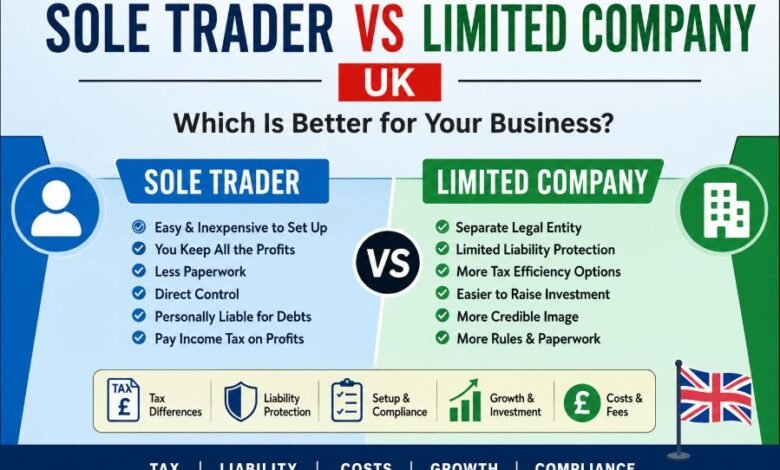
A sole trader is usually easier and cheaper to manage. A limited company provides stronger legal separation but requires more paperwork, accounting and reporting.
Neither structure is automatically better for everyone. The right choice depends on your business risk, expected profit, customers, growth plans and how much money you want to take from the business.
Sole Trader vs Limited Company Quick Comparison
| Feature | Sole Trader | Limited Company |
|---|---|---|
| Legal identity | Owner and business are the same | Company is legally separate |
| Setup | Simple | More formal |
| Government incorporation fee | No incorporation fee | £100 online as of August 2026 |
| Liability | Owner is personally responsible | Normally limited to the owner’s investment |
| Main business tax | Income Tax and National Insurance | Corporation Tax |
| Taking money | Owner can withdraw money freely | Money must be taken correctly |
| Accounts | Self Assessment records | Statutory company accounts |
| Public information | Less information is public | Company records are publicly available |
| Investors | Cannot issue shares | Can issue or transfer shares |
| Paperwork | Lower | Higher |
| Best for | Simple and low-risk businesses | Growing or higher-risk businesses |
What Is a Sole Trader?
A sole trader is one person running a business as a self-employed individual.
The owner controls the business and keeps its profits after paying tax.
A sole trader can:
- Sell products
- Provide services
- Employ workers
- Work from home
- Rent business premises
- Open a business bank account
- Register for VAT
- Use a trading name
The owner and business are not legally separate.
This means the owner is personally responsible for the business’s debts, contracts and legal problems.
How to Register as a Sole Trader
You can normally start trading before completing a formal registration.
You must usually register for Self Assessment when your gross trading income is more than £1,000 during a tax year.
Gross income means the total amount received before business expenses are removed.
A sole trader should:
- Choose a business or trading name.
- Keep records of income and expenses.
- Register for Self Assessment when required.
- Complete an annual tax return.
- Pay Income Tax and National Insurance.
- Register for VAT when required.
- Register as an employer when hiring staff.
The registration process is usually simpler than creating a limited company.
Sole Trader Liability
A sole trader has unlimited liability.
This means the owner may be personally responsible if the business cannot pay its debts.
For example, a sole trader may be personally responsible for:
- An unpaid business loan
- Supplier debts
- Customer compensation
- Rent owed on business premises
- Legal costs
- Tax debts
Business insurance can reduce some risks, but it does not create legal separation between the owner and the business.
A business with expensive contracts, large debts or a high risk of customer claims may need stronger legal protection.
Sole Trader Tax
A sole trader pays tax on business profit.
Profit is calculated using this basic method:
Business income − allowable expenses = taxable profit
Allowable expenses may include:
- Office costs
- Business telephone bills
- Advertising
- Insurance
- Stock and materials
- Staff costs
- Business travel
- Bank charges
- Professional fees
- Relevant training
- Business premises costs
Only the business part of an expense can normally be claimed.
For example, if a mobile phone is used for both personal and business calls, only the business-use portion should be treated as a business expense.
Sole Trader Income Tax Rates
For most taxpayers in England, Wales and Northern Ireland during the 2026–27 tax year:
| Taxable income | Income Tax rate |
|---|---|
| Personal Allowance up to £12,570 | 0% |
| Basic-rate income | 20% |
| Higher-rate income | 40% |
| Additional-rate income | 45% |
Scottish taxpayers use different Income Tax bands.
The Personal Allowance may also reduce when a person has a high total income.
Sole Trader National Insurance
Self-employed people may also pay Class 4 National Insurance.
For the 2026–27 tax year, the main Class 4 rates are:
- 6% on profits between £12,570 and £50,270
- 2% on profits above £50,270
The amount depends on the final taxable profit.
Sole Trader Record Keeping
A sole trader must keep clear records of:
- Sales
- Invoices
- Business expenses
- Bank transactions
- Receipts
- VAT records
- Staff payments
- Personal money introduced into the business
Using a separate business bank account is not always legally required for a sole trader, but it makes bookkeeping much easier.
Mixing personal and business transactions can make tax calculations confusing.
Making Tax Digital for Sole Traders
Making Tax Digital for Income Tax is being introduced in stages.
The planned starting dates are based on qualifying gross income:
| Qualifying income | Starting date |
|---|---|
| More than £50,000 | 6 April 2026 |
| More than £30,000 | 6 April 2027 |
| More than £20,000 | 6 April 2028 |
Affected sole traders generally need to:
- Use compatible software
- Keep digital business records
- Submit regular updates
- Complete the final return through software
This means some sole traders will have more reporting responsibilities than they had in earlier years.
Advantages of Being a Sole Trader
Easy to start
The setup process is simple and normally does not require a Companies House incorporation fee.
Less paperwork
A sole trader does not need to submit annual company accounts or confirmation statements.
More privacy
The owner’s business accounts and details are not automatically published through Companies House.
Easy access to money
The owner can normally move money from the business account for personal use without declaring a salary or dividend.
Suitable for testing an idea
A sole-trader structure can work well when someone is testing a small, simple or low-risk business.
Disadvantages of Being a Sole Trader
Personal responsibility for debts
The owner and the business are legally the same.
Limited investment options
A sole trader cannot issue company shares to investors.
Profit is personally taxable
The owner normally pays personal tax on the profit earned, even when some money remains in the business.
The business depends heavily on the owner
It can be more difficult to transfer ownership or bring in new owners.
Some clients prefer limited companies
Larger organisations may prefer to work with incorporated businesses.
What Is a Limited Company?
A limited company is a separate legal organisation registered with Companies House.
The company can:
- Own money
- Own equipment
- Sign contracts
- Employ people
- Borrow money
- Pay Corporation Tax
- Bring in shareholders
- Continue after an owner leaves
A private company limited by shares normally needs at least one director and one shareholder.
The same person can be both the director and shareholder.
How to Register a Limited Company
To form a private limited company, you normally need:
- A company name
- A registered office address
- A registered email address
- At least one director
- At least one shareholder
- A business activity code
- Articles of association
- Information about people with significant control
Online incorporation currently costs £100.
Directors and people with significant control may also need to complete Companies House identity verification.
Limited Company Liability
A limited company is legally separate from its shareholders and directors.
Shareholders are normally responsible only for the amount they invested or agreed to invest.
However, limited liability does not protect a director in every situation.
A director may become personally responsible when:
- They sign a personal guarantee
- They commit fraud
- They continue wrongful trading
- They misuse company money
- They break important director duties
- They improperly manage an insolvent company
A lender may ask the director of a new company to provide a personal guarantee before approving a loan.
Corporation Tax
A limited company pays Corporation Tax on its taxable profit.
Current Corporation Tax treatment includes:
| Company profit | Tax treatment |
|---|---|
| £50,000 or less | 19% small-profits rate |
| Between £50,000 and £250,000 | Marginal Relief may apply |
| More than £250,000 | 25% main rate |
The thresholds may be reduced when companies are connected with associated companies or have a short accounting period.
How a Company Owner Takes Money
Company money does not automatically belong to the director.
The owner normally takes money through:
- Salary
- Dividends
- Repayment of business expenses
- Repayment of money lent to the company
- A properly recorded director’s loan
Each method has different tax and accounting rules.
Taking company money without recording it correctly can create tax problems.
Salary From a Limited Company
A director may receive a salary through payroll.
Depending on the amount, the salary may create:
- Income Tax
- Employee National Insurance
- Employer National Insurance
- Payroll reporting duties
For 2026–27, the main employer National Insurance rate is 15% above the relevant employer threshold.
Some businesses can use the Employment Allowance, but a company with only one director as its only relevant employee may not qualify.
Dividends
Dividends are payments made to shareholders from available company profits.
A company cannot legally pay dividends when it does not have enough distributable profit.
For 2026–27:
- Dividend Allowance: £500
- Ordinary dividend rate: 10.75%
- Upper dividend rate: 35.75%
- Additional dividend rate: 39.35%
The company normally pays Corporation Tax before the remaining profit is available for dividends.
This is why dividend tax should not be considered alone when comparing a company with a sole trader.
Limited Company Filing Responsibilities
A limited company normally needs to complete several filings.
These include:
- Annual company accounts
- Corporation Tax payment
- Company Tax Return
- Confirmation statement
- Payroll reports when paying salaries
- VAT returns when VAT registered
Typical deadlines include:
| Responsibility | Typical deadline |
|---|---|
| First accounts | 21 months after incorporation |
| Later annual accounts | 9 months after the financial year ends |
| Corporation Tax payment | 9 months and 1 day after the accounting period |
| Company Tax Return | 12 months after the accounting period |
| Confirmation statement | At least once every 12 months |
Missing these deadlines can create penalties.
Public Company Information
A limited company must make certain information publicly available.
This may include:
- Company name
- Company number
- Registered office
- Directors
- Filing history
- Accounts
- People with significant control
- Confirmation statements
A director who does not want a home address displayed publicly should consider using a suitable professional registered-office or service address.
Advantages of a Limited Company
Separate legal identity
The company is legally separate from its owners.
Limited liability
Shareholders normally have stronger protection from company debts.
Easier to add investors
The company can issue or transfer shares.
Better for long-term growth
A company can retain profit for future investment and business development.
Easier ownership transfer
Shares can be transferred when an owner leaves or sells part of the business.
Stronger business identity
Some clients, suppliers and lenders may view a limited company as more established.
More financial-planning options
Directors may use salary, dividends and employer pension contributions, subject to tax rules.
Disadvantages of a Limited Company
More administration
The company must maintain records and complete annual filings.
Higher professional costs
Accounting, payroll and company-management costs may be higher.
Less privacy
Company details and filings can be viewed by the public.
Company money is separate
Directors cannot take money whenever they wish without recording it properly.
Late-filing penalties
Missing Companies House and HMRC deadlines can become expensive.
Limited liability has exceptions
Personal guarantees and director misconduct can still create personal responsibility.
Sole Trader vs Limited Company Tax
A limited company is not automatically more tax efficient.
A company may be helpful when:
- Some profit will remain inside the company
- The business will make employer pension contributions
- The owner does not need to withdraw all profit
- The company has more than one shareholder
- The business plans to reinvest
- Investors may join later
A sole trader may remain suitable when:
- Profit is modest
- Most profit will be withdrawn for personal use
- The business is simple
- Accounting costs would remove any tax saving
- The business carries limited risk
- There is no need for outside investors
There is no single profit amount at which every sole trader should create a company.
The full calculation should include:
- Corporation Tax
- Income Tax
- Dividend Tax
- Employee National Insurance
- Employer National Insurance
- Accounting fees
- Payroll costs
- Other personal income
- Pension contributions
- Student-loan repayments
- Money retained in the company
- Money withdrawn personally
VAT Rules
The main VAT registration rules generally apply to both structures.
A business normally needs to register for VAT when its taxable turnover:
- Exceeds £90,000 during a rolling 12-month period, or
- Is expected to exceed £90,000 during the next 30 days
Businesses below the threshold may register voluntarily.
Changing from a sole trader to a limited company creates a new legal entity, so VAT details may need to be transferred or updated.
Funding and Investment
A sole trader can apply for business loans and use personal savings.
However, the owner cannot issue shares because no separate company exists.
A limited company can:
- Issue shares
- Add investors
- Add shareholders
- Borrow in the company’s name
- Transfer ownership through shares
- Continue after the original founder leaves
A lender may still request a personal guarantee from the director of a young company.
Sole Trader vs Limited Company for Contractors
Some contractors use limited companies when working with business clients.
However, they must consider the off-payroll working rules, commonly called IR35.
These rules may apply when a contractor works through a company but would have been treated as an employee if hired directly.
When IR35 applies, the expected tax advantage of a personal service company may reduce significantly.
Changing From Sole Trader to Limited Company
A sole trader can create a limited company later.
The change may involve:
- Registering the company.
- Opening a company bank account.
- Telling HMRC about the change.
- Moving customer and supplier contracts.
- Transferring equipment, stock and business assets.
- Updating invoices and websites.
- Moving VAT registration when required.
- Registering company payroll.
- Starting company accounts.
- Reviewing possible tax charges.
Customers should understand that they are now dealing with a company rather than the original sole trader.
Can You Change Back to a Sole Trader?
A company owner may decide to close the company and continue as a sole trader.
However, this is not always a simple change.
The owner may need to deal with:
- Company debts
- Corporation Tax
- Business assets
- VAT
- Payroll
- Closing accounts
- Money remaining in the company
- Contracts
- Companies House closure rules
Professional advice may be useful before moving assets or money out of a company.
Which Structure Is Better for a New Business?
A sole trader may be better when:
- You are testing a new idea
- The business has low financial risk
- You work alone
- You want simple accounting
- You expect modest profit
- You do not need investors
- You want more privacy
A limited company may be better when:
- The business carries higher risk
- You want legal separation
- You plan to add shareholders
- You want outside investment
- The company will employ a growing team
- You plan to retain profit
- Larger clients prefer incorporated suppliers
- You may sell the business through shares
Questions to Ask Before Choosing
Ask yourself:
How risky is the business?
Consider debt, contracts, customer claims and expensive equipment.
How much profit do I expect?
Use realistic figures rather than sales targets alone.
Will I withdraw all the money?
A company may provide more flexibility when profit is retained.
Do I need investors?
A limited company is usually more suitable for share investment.
How much administration can I manage?
Company reporting requires more time and professional support.
Do important clients require a company?
Some organisations will only work with incorporated suppliers.
Do I need privacy?
Company information is more publicly available.
What are my future plans?
Think about employees, new owners, investment and selling the business.
For more simple guides on starting and managing a business, visit Business Blog Media.
Frequently Asked Questions
Is a sole trader the same as being self-employed?
A sole trader is one common form of self-employment. The owner runs the business personally and reports its profit through Self Assessment.
Is a limited company always better than a sole trader?
No. A limited company provides legal separation and more growth options, but it also creates additional costs and responsibilities.
Does a sole trader need to register with Companies House?
No. Sole traders normally register through HMRC rather than Companies House.
Can a sole trader employ staff?
Yes. A sole trader can employ workers but must register for PAYE and follow employment rules.
Can one person create a limited company?
Yes. One person can be the company’s only director and shareholder.
Is a limited company more tax efficient?
It can be in some situations, especially when profit is retained. It is not automatically cheaper for every owner.
Can a limited company owner take money whenever they want?
No. Company money must be taken through an approved method such as salary, dividends, expenses or a recorded director’s loan.
Does a limited company protect personal assets?
It normally provides limited-liability protection. Personal guarantees, fraud and serious breaches of director duties can still create personal responsibility.
When should a sole trader become a limited company?
There is no universal profit level. Consider risk, profit, clients, investment plans and total accounting and tax costs.
Can a sole trader change to a limited company?
Yes. Many businesses start as sole traders and incorporate after becoming larger or more complex.
Final Thoughts
A sole trader is usually the simplest structure for a small or early-stage UK business.
It offers easy setup, lower administration and direct access to business money. The main disadvantage is that the owner remains personally responsible for business debts.
A limited company creates a separate legal identity. It may provide better liability protection, stronger investment options and more flexibility for growth.
However, a company also requires annual accounts, Corporation Tax reporting, payroll management and careful handling of company money.
Do not choose only by looking at one tax rate.
The best structure depends on the business’s risk, expected profit, customers, investment plans and long-term goals.
UK tax and company rules can change. Business owners should review current requirements and consider professional advice before making an important structural decision.