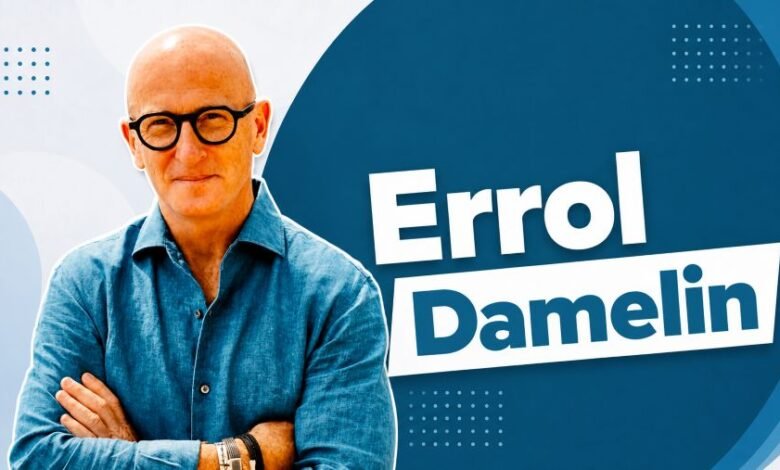
Errol Damelin: From Wonga Founder to Seed Investor
How a technology entrepreneur moved from building financial companies to supporting early-stage founders through Dust Road Ventures

Last Updated on July 27, 2026 by Business Blog Media Editorial Team
Introduction
Errol Damelin is a South African-born technology entrepreneur and investor. He is best known for co-founding Wonga, the British online lending company that became one of the most discussed financial technology businesses of its time.
He later helped create Tide, a digital financial platform designed for small businesses. After working as a company founder, Damelin moved his main attention towards early-stage investment.
As of July 2026, he is the founder of Dust Road Ventures. The seed-stage investment firm supports technology companies working in financial technology, artificial intelligence, health technology and business software.
His current firm says he has made more than 75 early-stage investments since 2011. These investments include Wise, Purplebricks, HiBob, K Health, Cleo, Elliptic, Citymapper, YuLife and Zoe.
Errol Damelin Quick Facts
| Detail | Verified information |
|---|---|
| Full name | Errol Damelin |
| Born | August 1969 |
| Grew up in | Klerksdorp, South Africa |
| Profession | Technology entrepreneur and investor |
| Best known for | Co-founding Wonga |
| Other major company | Tide |
| Current role | Founder of Dust Road Ventures |
| Current base | London |
| Main investment areas | Fintech, AI, health technology and enterprise software |
| Reported investments | More than 75 since 2011 |
Who Is Errol Damelin?
Errol Damelin is a company founder who became an early-stage technology investor.
His career includes work in manufacturing, corporate finance, supply-chain software, online lending and digital business finance. He has built companies in several different industries rather than remaining focused on only one type of business.
Damelin became widely known through Wonga. The company used online systems and automated checks to provide short-term consumer loans. Its technology helped make it an important early fintech company, but its high-cost lending model also attracted strong criticism.
Damelin left Wonga years before the company entered administration. He later became involved in Tide and developed a large investment portfolio.
His present work is focused on finding founders who understand a difficult problem and can use technology to create a new solution.
Early Life and Education
Damelin grew up in Klerksdorp, a mining town in South Africa’s North West Province.
His current investment company says the open land and unpaved roads around his childhood home later inspired the name Dust Road Ventures.
He studied engineering and business at the University of Cape Town. He later completed graduate study at Boston University.
Before moving fully into entrepreneurship, he worked in corporate finance. This gave him experience of how companies raise money, manage financial decisions and prepare for growth.
He moved to London in 1999. The city later became the main base for his company-building and investment work.
His First Business Experience
Damelin’s early career was not connected to online lending.
During the 1990s, he became involved with Barzelan, a specialist steel-wire manufacturing company in Israel. The work exposed him to manufacturing, stock control, industrial supply chains and international business operations.
This experience helped him understand how difficult it could be for companies to organise purchasing, deliveries and supplier information.
He later used this knowledge when building his first major technology company.
Founding Supply Chain Connect
Damelin founded Supply Chain Connect in 2000.
The company developed online software that helped industrial businesses manage purchasing and supplier relationships. Its services were designed for companies with complicated supply chains and large numbers of business partners.
Building a technology company during the early 2000s was difficult. Many internet businesses were closing after the dot-com market crash.
Supply Chain Connect continued operating and gained business customers in the United Kingdom and the United States. ChemConnect acquired the company in 2005.
The sale gave Damelin experience in creating, growing and eventually selling a technology business.
His early career shares some lessons with other founders in technology entrepreneurship, where a practical software solution can grow from one industry problem into a larger company.
How Did Errol Damelin Start Wonga?
Errol Damelin and Jonty Hurwitz co-founded Wonga in 2006.
They wanted to create a faster way for people to apply for short-term credit online. Traditional loan applications could require paperwork, phone calls and long waiting periods.
Wonga developed an automated system that reviewed information and made lending decisions quickly. Its online service became fully active in 2007.
Customers could select how much money they wanted to borrow and how long they wanted to keep it. The platform then displayed the cost before completing the application.
The technology was unusual at the time. It showed how data and automated systems could change consumer lending.
Why Did Wonga Become Famous?
Wonga became famous for two main reasons.
First, it was one of the early British fintech companies to provide a completely online and highly automated borrowing process.
Second, it offered short-term loans with high costs. This made the company controversial.
Supporters viewed Wonga as a fast and convenient alternative to bank overdrafts or other forms of emergency borrowing. Critics argued that high-cost loans could make financial problems worse for people who were already struggling.
The company grew quickly and attracted investment from major venture-capital firms. It became one of the most recognisable names in British online lending.
However, its growth also brought closer attention from politicians, consumer organisations and financial regulators.
When Did Errol Damelin Leave Wonga?
Damelin stopped serving as a director of Wonga.com in November 2013.
Companies House records show that he resigned as a director of Wonga Group in June 2014.
This timeline is important because Wonga continued operating for several years after his departure. The company entered administration on 31 August 2018, more than four years after he had formally left Wonga Group.
Damelin is therefore the co-founder and former chief executive of Wonga, not its current leader.
Wonga’s Regulatory Problems
Wonga faced serious regulatory criticism over some of its business practices.
In June 2014, the Financial Conduct Authority reported that Wonga would pay more than £2.6 million in compensation to around 45,000 customers.
The regulator found that letters had been sent to some customers using the names of legal firms that did not exist. Some customers were also charged fees connected with those letters.
The practices happened between October 2008 and November 2010, when Damelin was leading the company. However, the FCA announcement concerned Wonga as a company and did not present it as an individual regulatory ruling against Damelin.
Later in 2014, Wonga also agreed to make major changes to its lending checks and provide financial redress to customers affected by weak affordability assessments.
The company eventually entered administration in 2018 after facing a large number of customer compensation claims.
This part of Wonga’s history shows that rapid financial innovation must be supported by careful customer protection, strong company controls and responsible lending standards.
Errol Damelin and Tide
After Wonga, Damelin became involved in another financial technology company called Tide.
He co-founded Tide with George Bevis in 2015. The platform was created to make financial administration easier for small companies, freelancers and independent workers.
Tide allows members to use digital tools for business accounts, payments, invoices and expense management. It publicly launched in the United Kingdom in 2017.
Unlike Wonga, Tide was created around small-business financial services rather than short-term consumer lending.
Damelin helped support the company during its early development, but he is not part of its current executive leadership. His role is best understood as a co-founder and early supporter.
Becoming an Early-Stage Investor
Damelin began making technology investments while he was still involved in building companies.
Over time, investing became his main professional focus.
He usually invests at the seed stage. This is an early part of a company’s life when it may have an idea, a small team or an early product but has not yet become a large business.
Early investment carries significant risk. A young company may fail, change direction or struggle to attract customers.
However, an early investor may also support a company before its potential becomes clear to the wider market.
Damelin’s investment approach focuses on founders with detailed knowledge of the problem they are trying to solve. He looks for people who have learned about a market through direct work or personal experience.
This connects with basic principles of entrepreneurship, including planning, people, profit, passion and perseverance.
Founding Dust Road Ventures
Damelin formalised his investment work by establishing Dust Road Ventures in 2024.
The company describes itself as a seed-stage investment firm. It normally provides a company’s first or second major investment cheque.
Dust Road Ventures concentrates on four main areas:
- Financial technology
- Artificial intelligence
- Health technology
- Enterprise software
The firm is globally active but has a strong focus on the United Kingdom, Europe, Israel and the United States.
It uses permanent private capital rather than operating like a traditional venture-capital fund with a fixed timetable. This structure can allow the firm to remain invested without facing the same pressure to return outside investors’ money within a set period.
Why Is It Called Dust Road Ventures?
The name comes from the landscape around Klerksdorp, where Damelin grew up.
A dust road may lead towards a place that has not yet been fully developed. It can be harder to follow than a finished main road, but it may also lead to a new opportunity.
Damelin uses this idea to explain his investment strategy.
He is interested in companies operating before a market becomes crowded. These businesses may be working on technology that customers do not yet know they need.
The name represents investing before the road becomes clear and before most other investors arrive.
Which Companies Has Errol Damelin Invested In?
Dust Road Ventures reports that Damelin has made more than 75 investments since 2011.
Publicly named companies include:
Wise
Damelin invested in Wise when the international money-transfer company was still at an early stage and had not yet started generating revenue.
Wise later became a major international financial technology company and listed its shares in London.
Purplebricks
He was an early investor in Purplebricks, an online estate agency that used technology to change parts of the traditional home-selling process.
HiBob
HiBob develops human-resources software that helps companies manage employees, workplace information and business processes.
K Health
K Health uses technology and artificial intelligence to support digital healthcare services.
Cleo
Cleo is a financial technology platform that helps users understand spending, budgeting and personal money management.
Elliptic
Elliptic develops tools that help financial institutions and other organisations identify risks connected with digital assets and blockchain transactions.
Citymapper
Citymapper created a journey-planning application that helps people understand public transport routes in major cities.
YuLife
YuLife combines employee insurance and workplace benefits with technology designed to encourage healthier daily habits.
Zoe
Zoe is a health-science company that uses research and digital tools to help people understand nutrition and personal health information.
What Is Errol Damelin’s Investment Strategy?
Damelin looks for founders who deeply understand a problem.
He does not only study presentation slides or financial predictions. He wants to know why the founder is the right person to build the company.
His strategy can be explained through four simple ideas.
Invest Early
He usually invests before a company becomes widely known.
Study the Founder
He looks for people with direct knowledge of the market rather than founders who are only following a popular trend.
Focus on Large Problems
The firm prefers industries where existing systems are slow, expensive, confusing or outdated.
Support New Technology
Its investments often involve software, data, artificial intelligence or digital financial tools.
What Is Errol Damelin Doing Now?
As of July 2026, Damelin’s main public role is founder of Dust Road Ventures.
He is no longer running Wonga and is not part of Tide’s current executive team.
His work now includes:
- Finding early-stage technology companies
- Providing seed investment
- Advising founders
- Helping companies prepare for later investment
- Sharing lessons from his experience as a company builder
- Writing about startups and investment decisions
His career has therefore moved through three major stages: corporate finance, company building and early-stage investment.
What Can Entrepreneurs Learn From His Career?
Solve a Real Problem
Supply Chain Connect grew from problems Damelin observed in industrial supply chains.
Strong companies often begin by solving a clear problem rather than creating technology without a purpose.
Technology Is Only One Part of a Business
Wonga had advanced technology, but its history also showed the importance of regulation, customer treatment and responsible company controls.
A fast system is not enough when a business affects people’s financial lives.
Experience Can Improve Investment Decisions
Damelin built companies before becoming a full-time investor.
This operating experience can help an investor understand staffing, sales, regulation, product development and pressure inside a young business.
Early Investment Requires Patience
Seed-stage companies usually need time to test their products, find customers and build strong teams.
Investors must understand that progress is not always fast or simple.
Learn From Difficult Periods
A useful business story should include both growth and failure.
Wonga achieved rapid growth but later faced serious regulatory and financial problems. Its history offers lessons about the risks of expanding before every part of a business is ready.
Why Is Errol Damelin Important in UK Fintech?
Damelin was involved in several important stages of the British fintech industry.
Wonga showed how lending decisions could be automated and delivered online. Tide later focused on digital tools for small businesses. His investments have also supported companies working in payments, personal finance, insurance, fraud detection and financial management.
His public reputation remains closely connected with Wonga and the debate around high-cost credit.
However, his wider career also includes company building, seed investment and early support for technology businesses that later became internationally recognised.
Frequently Asked Questions
Who is Errol Damelin?
Errol Damelin is a South African-born technology entrepreneur and early-stage investor. He is best known for co-founding Wonga and later helping create Tide.
What is Errol Damelin famous for?
He is mainly famous for founding and leading Wonga during its early growth. He is also known for investing in technology companies such as Wise, Purplebricks, Cleo and HiBob.
Does Errol Damelin still own Wonga?
Wonga no longer operates as an active lending company. Damelin left Wonga.com in 2013 and Wonga Group in 2014. The company entered administration in 2018.
Was Errol Damelin the founder of Tide?
Yes. He co-founded Tide with George Bevis in 2015 and supported its early development.
What is Dust Road Ventures?
Dust Road Ventures is a seed-stage investment firm founded by Errol Damelin in 2024. It invests in fintech, AI, health technology and enterprise software.
How many companies has Errol Damelin invested in?
Dust Road Ventures reports that he has made more than 75 early-stage investments since 2011.
Where does Errol Damelin live?
His current professional profiles place him in London. He also maintains strong personal connections with Southern Africa.
What companies did Errol Damelin build?
His current firm identifies Supply Chain Connect, Wonga and Tide as the three main companies he helped build.
What does Errol Damelin do today?
As of July 2026, he works as an early-stage investor through Dust Road Ventures. He supports founders who are building new financial, health, AI and business-software products.
Conclusion
Errol Damelin is a technology entrepreneur whose career has included industrial software, online lending, small-business finance and startup investment.
He became publicly known through Wonga, a company that combined important financial technology with a highly controversial lending model. The company’s later regulatory problems remain an important part of its history.
Damelin left Wonga in 2014 and later helped establish Tide. He then built a broad portfolio of early-stage investments.
Today, his main work is Dust Road Ventures. The firm supports technology founders at the beginning of their business journeys, often before their products or markets are widely understood.
His career provides a balanced business lesson. New technology can create major opportunities, but lasting growth also requires responsible leadership, careful controls and a clear understanding of how a company affects its customers.